|
|
| |
 |
|
|
 |
|
Shree
Jivanbhai's Vision  Shree
Jivanbhai's Mission
Shree
Jivanbhai's Life
Shree
Jivanbhai's Mission
Shree
Jivanbhai's Life
Swamiji's
Prayers
Shree
Jivanbhai's Legacy |
|
\
Shree
Jivanbhai Gadher's
Life
(1920
to 2004)

Majestic 84
MAN OF STEEL WITH A GOLDEN HEART |
|
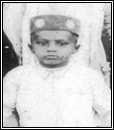
Childhood
|
This amazing boy was born and there was rejoicing and happiness all around. Parents and elders were filled with pride and joy at the fearlessness of the little boy. The younger ones loved and admired him and wanted to be his friends. As he grew up, he started to make many friends and pretty soon he had a large friend circle. |

Youth
|
|
|
He could be seen playing
‘Gilly – Danda’ (Indian game played with a stick and a small piece of wood),
‘Sunta – Kukdi (hide and seek) and ‘Kabadi’ (Indian game of trapping the wild boar). No companion of his ever disobeyed him as he was the most daring and brave of them all. By nature he rebelled against injustice. Even at that tender age, he showed a genuine interest in the welfare of his companions and constantly enquired about their needs and problems.
|
|
|
|
|
|
|
He helped them as best he could and such actions promoted a strong bond of friendship for
him. Typical examples are where he would give away free milk and cream to the poor friends and their family instead of selling it. When questioned about what happened to the milk, he always made up an excuse such as ‘I drank it because I was very thirsty’ or the horse threw me and spilt all the milk or the common one was that the other brothers drank it and hence there was nothing left to sell!
|
|

|
|
Childhood was a carefree one and a very happy phase of life for Shree Jivanbhai. Despite being one of the ten siblings, he was extremely close to his mother Viru ma who called him by the endearing name of ‘Jivno’. Despite all the mischief he got up to, he was always the one who was missed if he was not around and equally readily forgiven if caught doing something he should not have been doing. Parental love and approaches to Shree Jivanbhai were totally different. Viru ma would secretly feed him milk, cream, ‘rotla’ (leavened bread cooked on open fire) ‘Oro’ (aubergine cooked in ghee and with salt and spices), almonds and cream. He was well pampered and a very strong bond grew between mother and son as time progressed. On the other hand Nathoo bapa was a true ‘Vashnauv’ (religious and a strong follower of all rules) and an extremely strict disciplinarian who was intolerant to truancy and mischief. While playing truancy, if Nathoo bapa was noticed approaching, young ‘Jivno’ would dive into the local pond and hold onto the undergrowth till father had gone. Friends used to be amazed as to how long he could stay under water and often thought he had
drowned, only to see him turn up from somewhere else.
|

|

|
|
|
|
 
|
He loathed working on the farm, picking and taking ‘mandavi’ (green peanuts) to the market or ploughing the fields but enjoyed looking after the cows. In fact he was at one with animals and at the end of the day he would fall asleep on the back of the largest cow as they made their way home. He would only wake up when the cow threw him off its back at the front entrance – what a wonderful relationship this was with his animals! He lived a blissful life and in his young age was totally oblivious to the outside World and the ‘on-going’ political problems in India.
|
|
|
|
|
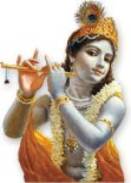
Mischievous Youth of Krishna
‘Youth’
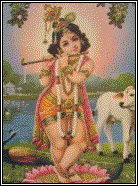
Books could be written about the youth and adventures of Shree Jivanbhai that are in many ways comparable to the mischievousness’ of young Lord Krishna and his stories about milk, butter, cows and the young friends around him. One incident which the whole village never stopped talking about and that needs a mention is what happened on one hot sunny afternoon. Neighbour Shree Hansraj Bapa had a habit of napping in the afternoon by the window with bars and would snore loudly with his mouth wide open. Shree Jivanbhai always found this sight amusing as well as tempting to do something about it. So on this occasion, he challenged each of his friends to put a pebble into Shree Hansraj Bapa’s mouth. This they did with him being the first. Can you imagine the uproar! News soon reached Nathoo Bapa and for three days Shree Jivanbhai avoided getting caught by his father. By the time he was finally cornered, he had already convinced everyone that he was trying to get him to keep his mouth shut so that the flies did not enter! – that is everyone except Nathoo Bapa. He got away with light punishment and the whole village mused about the incident for weeks on end. Many old timers remember this incident and still have a good chuckle.
|
|
Mansoon
|
|

|

|
|
.... there is a terrible sense of waiting for something that is not happening.
For the farmers in Ranavav, the great worry is the monsoon and the whole waiting for rains. It is the most dramatic thing that happens in India and for an agricultural community, it is so crucial to their existence that it is highly respected and prayers are said to the Gods. The whole wait for rain by mid-June becomes intense and it can determine your survival or your demise..…….. there is a terrible sense of waiting for something that is not happening. To go hand in hand with this is the very unbearable heat, the blue, harsh sky and that sun bearing down making the earth crack. It is a horrible and terrible feeling.
|
|
‘The Lu Wind’ and the Monsoon
The wrong sort of breeze is called the
‘Lu Wind’ and it can drive you quite literally mad. The sun makes an ally of the breeze and it heats the air until it becomes the ‘Lu’. Even in the intense heat, the ‘Lu's’ caresses brings up prickly heat and produces a numbness which makes the head nod and the eyes heavy with sleep ‘ Lu winds’ come from the deserts of Rajasthan. The locals call this final period of intense heat
Mirgassa. It begins at the full moon and lasts fifteen days. The farmers have many sayings about the Mirgassa such as - the sun is so hot that deer turn black! |

‘Joy when the
rains arrive’
|
|
|
|
‘Failed
Monsoon’
As
time went on and despite previous punishments and
disciplinary actions, a very strong bond started to
develop between Shree Jivanbhai and Shree Nathoo Bapa in
years to come. In fact, he was to become his Father’s right hand man in
face of trouble. Harassment
from surrounding communities of ‘Mehrs’ and
‘Kharvas’ started when the monsoons failed and the
crop did not grow. Shree Nathoo Bapa had to borrow money to feed the
family and the money could not be repaid till the next
harvest. As
is usually the case that when one is venerable, others
see this as an opportunity to take advantage and hence
all sorts of harassment started. Young Shree Jivanbhai could not bear to see his father
bullied and his blood boiled with rage. One day when he saw Nathoo Bapa being ‘man –
handled’, he picked up the nearest bullock shoulder
piece (large heavy wooden piece which rests on the
bullocks’ neck) and laid into the four offenders.
So ferocious was his response that the four never
returned to trouble Nathoo Bapa ever again. He dealt with several other troublemakers in a
similar fashion. These incidents touched Shree Nathoo
Bapa’s heart and when the monsoons returned and all
was fine, he rewarded Shree Jivanbhai with two things
– a white horse and a title of ‘Jivan Darbar’ or
‘Jivan the Brave’.
|
|

|

|
|
'BELOVED HORSE ‘TOFAN’
As times changed, more such incidents took place and Shree Jivanbhai was always at hand when trouble started or was needed. Elder brother Shree Ramjibhai who was equally strong and brave stood side by side him on many an occasion to tackle anything that came their way. Pretty soon they were handling many of the village problems too and both were formidable in their endeavours to protect the Gadher Family name and the safety of Rananvav, which was than a small venerable village. There were occasions when all the ‘Gadher Brothers’ had to stand shoulder to shoulder and were often joined by their neighbour’s son Shree Ramabhai Sikotra - a close friend of brother Ramjibhai. They now were a force to be reckoned with and intruders or troublemakers kept well away from them. The present of the white horse from his father for his dedication and bravery was a love of his life for Shree Jivanbhai. He named his horse ‘Tofan’ (whirlwind) because often it would throw him off, only to run away briefly but always returned to pick him up again. He would be seen proudly galloping across the fields. Soon he acquired superb bareback riding skills for which he was well respected in the village. Often he would ride it through the village ponds and rivers while clinging onto its mare. The horse was a Marwari thoroughbred and an incredible strong swimmer, jumper and galloper. He even delivered milk on horseback to villagers. It was never clear how much milk was delivered and how much was drunk by himself. However, it was also known that he secretly give away free milk to the needy and ill friends!
|
|
‘Value of Education’
Shree Jivanbhai’s cherished ambition was to make ‘something’ of his life rather than just look after the cows or toil in the fields. In order to realize his ambition, he had to continue his studies. But his family was in utter poverty and did not have enough money to send him for further education in India. So it was the farm for him until he figured something out.
|
|

Women toil relentlessly
|

Our daughters, sisters, mothers
|
|
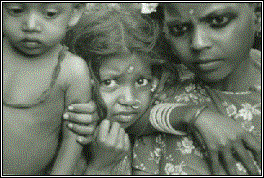
Life in Ranavav was tough and men and women alike toiled to earn a living. Daughters, sisters and mothers were part of the survival struggle and worked relentlessly. Shree Jivanbhai wanted a different life for himself. Every day, he would get up at four in the morning. Then he would feed the cows, remove the cow dung and clean the sheds. Next he milked the cows and set off to sell the milk on horseback. It was all systematic, and tidily done day in and day out. With limited opportunities to study, Shree Jivanbhai decided that he would persist with Gujarati, which would enable him to read the newspapers and learn more about the ‘Big World’ out there. He secretly took lessons to read and write from friends and in return would give them milk and cream. When questioned by his mother as to where all the milk went, he always made excuses as before. With constant repetition of the same piece of writing, he started to drastically improve his handwriting, which in later life was admired by all. With time, he became a perfectionist and he thought hard as to what he wanted to write before he wrote a word or a sentence. Reading his letters and Diwali Cards was always a pleasure because one knew that he would have written sometime special and from the bottom of his heart.
|
|
 |
|
Select words and meaningful writing in stylish handwriting
(Additionally later on in life, Shree Jivanbhai developed a thirst for reading and writing Sanskrit and spent many an hour studying this ancient language, which enabled him to translate aspects of several old vedic documents such as the ‘Vedas’, ‘Upanishadas’ and ‘Puranas’. He also translated the ‘Shiksha Patri’ - held in the Bodleian Library, Oxford so that he could explain to others its contents. This particular ‘Shiksha Patri’ was a gift from Sahajanand Swami in 1830 to Sir John Malcolm in Rajkot).‘Awakening’ One day out riding, an encounter took place that was to totally change Shree Jivanbhai’s life. Galloping on ‘Tofan’, he saw another white horse and rider in the distance. Intrigued, he rode fast and soon caught up with the horse and ride – obviously a gentry judging by his attire. A conversation about horses was followed by a comparison of occupations, life styles, interests and education. After this encounter, Shree Jivanbhai rode around till nightfall mulling over the conversation in his mind. That night he decided to give away ‘Tofan’ and to re-evaluate his life. The gentry, he happened to be talking to was non other than Shree Rana Sahaib of Porbandar (HH Maharaja Rana Sahib Shri Sir NATWARSINHJI BHAVSINHJI Bahadur)
|
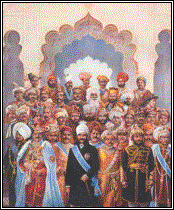 Princes of India including ‘Rana Sahib of
Porbander’ Princes of India including ‘Rana Sahib of
Porbander’
Their conversation had opened his eyes and made him aware that there was a ‘Big Wide World’ out there and that sacrifices were needed if he were to even become a slight part of it. Question of education kept creeping up over and over again and this is something he lacked and needed to address. He started to study with single-minded devotion. Nothing going on around him tempted him any more. All through his life, troubles never discouraged him. With a will of iron he would undertake whatever task lay in front of him. Shree Jivanbhai started to spend more time in the evening sitting by the open fire and talking to Viru ma, pouring out his heart and thoughts to her. They would talk for hours and Viru ma had to, many a times force him to go to sleep as a long day awaited him each time. She understood exactly what he was trying to say or do and it pained her immensely as she knew that she would not be able to bear her favourite child going away from her to study or work. India was in turmoil and were these troubled times in and around
Ranavav.
|
|
 |
The
sacred ‘Tricolor |

|
|
|
Shree Jivanbhai started to take a keen interest in the local and national news and at that moment in time on the scene was a gentleman called Gandhiji who preached Satyagraha (non-violent non-cooperation). Shree jivanbhai laughed at Satyagraha and service to the country as dreams of a crazy fellow. Gradually the spell of Gandhiji spread all over Gujarat. It changed Shree Jivanbhai’s thinking too.
|
|
 Shree
Jivanbhai joined the fight for the
Freedom of ‘Bharat Mata’ and pretty
soon he was an active member, as he
could not bear to see the daily
atrocities being carried out on the
local Bharatis. At one stage the
occupational government ordered that no
one should carry the ‘tri-coloured’
flag in any road.
Who could object to the display
of our flag in our own country asked
Shree Jivanbhai? And the first thing he did was to go out and purchase a
tricolour flag of Bharat Mata? This was the tricolour flag that was to accompany him everywhere he went and eventually to Kenya and then to UK and eventually draped over his coffin at his final demise. The people decided to disobey this offensive order about the flag and after three and a half months of agitation, the government withdrew the order and the satyagraha ended in a victory for the people. Shree
Jivanbhai joined the fight for the
Freedom of ‘Bharat Mata’ and pretty
soon he was an active member, as he
could not bear to see the daily
atrocities being carried out on the
local Bharatis. At one stage the
occupational government ordered that no
one should carry the ‘tri-coloured’
flag in any road.
Who could object to the display
of our flag in our own country asked
Shree Jivanbhai? And the first thing he did was to go out and purchase a
tricolour flag of Bharat Mata? This was the tricolour flag that was to accompany him everywhere he went and eventually to Kenya and then to UK and eventually draped over his coffin at his final demise. The people decided to disobey this offensive order about the flag and after three and a half months of agitation, the government withdrew the order and the satyagraha ended in a victory for the people. |
|
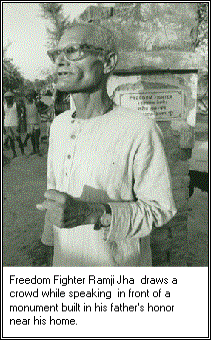 |
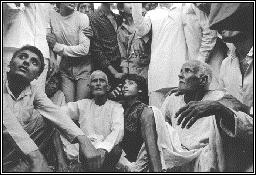
Poverty
and fear kept people away from
politics until Gandhiji came to the scene

|
|

Meagre existence
|

Sanitation and water an issue
|
|
Shree Jivanbhai was now completely in favour of
‘Swaraj’ (independence) and made it his own goal to participate and help wherever he could. Congress called on the British to quit India. It started what came to be known as the 'Quit India Movement' or the 'Chalejav
Movement'. The government jailed all the important leaders of the Congress and hence it was up to the free people outside to take on the struggle. Shree Jivanbhai became an active member and this involvement was to continue thereafter even in Kenya. Shree Jivanbhai’s plain words made people angry at times but it showed the superb self-confidence of this mighty man. He would say, "I cannot speak anything but the truth. I cannot turn my back on my beliefs just to please someone."
|
|

City realities for Survival
|
|
 |
|
City Slums and the contrasts |
|
Atrocities
Atrocities being carried out in India got worse and this made Shree Jivanbhai and thousands of others to oppose the Occupation. He would often remind people of the barbarity and suggested that it was everyone’s duty to join the struggle for the freedom of the motherland. He would talk about the very tragic event that happened in India. One incident he often spoke about which would bring tears of rage to roll down his cheeks was the
Jallianwala Bagh incident. The British soldiers opened fire on a gathering in Jallianwala Bagh, and kept up the fire for quite some time. There was no way of escape for the people. Countless persons – grown up men, women and little children fell down dead. Blood flowed like a stream. The event caused terror and anger in the minds of people all over the country. The tragedy drew the attention of the entire world. British soldiers had acted in a brutal manner against an innocent and unarmed assembly of people who had gathered for a meeting at Jalian- wala Bagh in Punjab.
|
|
Family Sorrow |
|

Shree Ramjibhai Gadher Brave’ like Jivanbhai
|
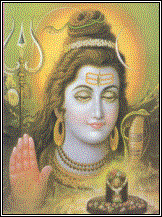
Creator and the Destroyer Lord Shiva
|
|
Sadness
was to hit the Gadher household
one day.
When one evening working
on the farm the elder brother
Shree Ramjibhai was bitten by a
snake.
He did not realise that
it was a snake but thought it
was an insect.
Slowly the poison took
effect and when he realised what
was happening, he was too weak
to take any action.
Brave Shree Ramjibhai
always carried an axe and had he
known, he was that sort of a
person who would have not
hesitated to chop off the
affected leg or slit his veins
to rid the poison.
He still managed to get
home from the farm in a bullock
cart.
People went searching for
the local snake catcher – a
Fakir known as ‘Akinsha’
but they could not find him.
By this time the poison
had taken effect and he knew he
would not survive.
Tears used to roll down
Shree Jivanbhai’s check each
time he remembered this sad day.
Both brothers hugged each
other crying and Shree Ramjibhai
apologised profusely for any
mistakes he may have made and
for making him work hard whereas
Shree Jivanbhai apologised to
him for often not obeying him,
falling asleep at work and for
frequently stealing food from
his tiffin (lunch box).
Viru ma and Nathoo Bapa
could not bear to see their
beloved son slowly ebb away.
The whole of Rananva came
to a stand still for two days
and everybody were shocked at
what had happened.
Tribute came pouring in
from so many people
- the ‘Gadher Group of
Brothers’ was never to be the
same again.
In-fact, this was to be a
turning point and the
fragmentation of the family
group
|
|
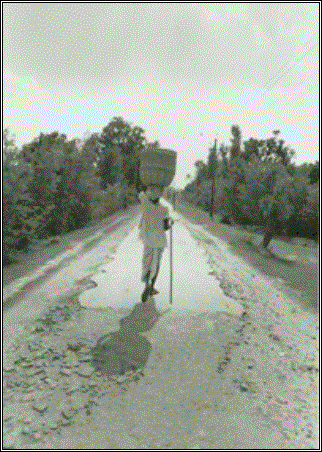
Goodbye to Mother and to
‘Mother Land Bharat’
|
Viru
ma could feel the sadness in
Shree Jivanbhai’s heart and
seeing him toil alone daily with
a heavy heart and sadness was
too much for her to bear.
She worried so much about
Shree Jivanbhai being alone in
the night on his own on the farm
that she started to get
nightmares and could not sleep.
She decided that she
would rather see him go away
from her now so that he could
fulfil his dream than stay there
with a limited future.
She decided to speak to
her brother Shree Virjibhai
Bechar Dhokia who was already in
East Africa.
Nathoo Bapa too now
resigned to the fact that
farming was just a means to an
end and that a better future was
elsewhere for his children.
Unlike Viru ma he spoke
little and hid his emotions and
being very strong mentally,
carried on with the farm and the
daily chores.
|
|
Africa
Shree Jivanbhai was eventually sponsored by Shree Virji Bechar Dhokia (mama) and supported by elder brother Meraman Gadher. Documents soon arrived from Kenya. Shree Jivanbhai left India for Kenya, East Africa by Ship with a handful of possessions including a
Tricolour flag of India and a photograph of Lord
Krishna. Journey took 30 days. |
|

|

|
Out there was a different world with a different race of people, a different language (Swahili) and a totally different way of life. Adjusting to the new way of life was difficult and fraught with problems. If he were to realise his dream, he needed to be a master of his destiny and not a servant to a false master. With this in mind he ventured out to Nairobi alone to make a fresh start and to indulge in what he liked best.
|
|
Quest for Knowledge and direction |
|

Shree Swami Rama Krishna Paramhansha
|

Shree Swami Vivekananda
|
|
Shree Jivanbhai acquired a thirst for knowledge and hence joined the Theosophical Society, Nairobi. This gave him a chance to interact with interesting people on a ‘one to one’ bases. He forged friendships with diverse groups of people and participated in ‘Satsang’, philosophical and political discussions. He continued his quest for further education by reading books.
Soon, he became an avid reader and started to study aspects of the Vedas, Puranas and the works of Shree Swami Vivekananda and Shree Swami Rama Krishna Paramhansha. At this stage, he realised a need for a ‘Guru’ in his life. In his time, he had seen a lot of fakes so called Gurus, Saints and Priests and he set out in earnest to seek a true Guru for himself. This hunt was to go on for several years before he actually found one.
|
|
Politically active young Shree Jivanbhai
|
‘Patriotic Front’ Shree Jivanbhai was now an active member of the
‘Patriotic Front’ and ‘Freedom Fighters’ for the Independence of India. Everyday news of atrocities in India was difficult to bear and he could not bear to see the sufferings especially of women and children. His faith in God and in religion was not obvious to outward view. But this was to change when he came in contact with Shree Purshotambhai Jethwa who was also fondly know as Shree Bhagat. He was always deeply indebted to him and others who gave him guidance and a deeper insight into ‘Hinduism’.
|
|

Swastika Symbol
|
‘Swastik Vyayamshala’ Around this time he saw too many young people around him drifting into bad habits such as drinking, smoking, gambling and ill repute. Shree Jivanbhai could see that they no longer had anyone to give them direction, advice or guidance. These were young people who had left homes in search of a better life and were disillusioned and looking for direction or inspiration. Shree Jivanbhai rose to this challenge by starting a ‘Vyayamshala’ (School for exercising).
|
|
He rented a small piece of land in Nagar, Nairobi and set about building the necessary apparatus such as single bar, double bar, a pit for wrestling, a route for running, weights, lathis (wooden sticks used in attack and defence). What he needed now was a name for the Vyayamshala and some participants. His studies of the Vedas had made him aware of the need to liberate oneself from the cycle of rebirth and had come across the very auspicious and a pious symbol –
the Swastika. He adopted this for his Vyayamshala - a wonder name and a wonderful logo for a wonderful cause – to better lives of one self and others in need!
The red arms of the swastika represent the four possible states (gatis) of rebirth: human, heaven, hell, and animal. These four states are represented clockwise starting from the upper left corner on the Swastika. One’s aim should be of liberation from these four states of rebirth. The three green dots above the Swastika represent the three jewels of Hinduism –
Samyak Darshan, Samyak Jnän and Samyak Chäritra. This represents the Hindu path of liberation. At the very top there is a small yellow crescent called Siddhashilä, a place for liberated souls. The yellow dot above the crescent represents a Siddha or a liberated soul. In order to achieve this stage, a soul must destroy all attached karmas. Every living being should strive for this state of Liberation or
Moksha.
The word ‘Vyayamshala’ stands for a school where one can exercise the body and mind for the betterment and well being of a person. Shree Jivanbhai’s philosophy was to combine sports, academic (Gujarati and Sanskrit education) and Indian Culture to create a
‘Brother Hood’ of men so that people could better their lives and move away from the wrong path of disrepute. The ‘Swastik Vyayamshala’ was born on a sprawling 5436-square yard site in one of the remote parts of Nagara near the famous ‘River Road’ in Nairobi. This humble centre started to gel and sporting excellence started to emerge in the form of wrestling, kabaddi, gymnastics, sword fighting, lathi, swimming, diving and bodybuilding. Shree Jivanbhai cemented the hope of sustaining traditions of thousands of year from India in stone. |
|

‘A Giant of a Man’ |
|
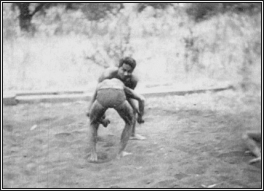
Hand dug wrestling pit and bouts with different members
|
|
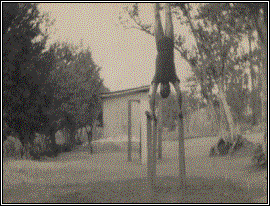
Hand built single and double bar
apparatus and regular training
|
|
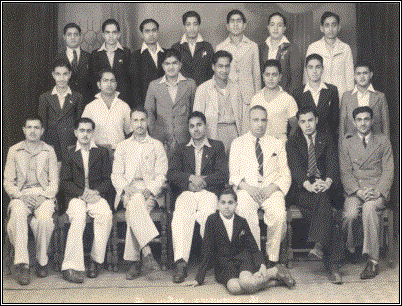
First group photograph as the ‘Swastik Vyayamshala’ started to grow
|
|
An initial total of three friends eventually turned to a mind-boggling 100 or more trainees who started to attend and the numbers grew daily. Individual involvement kept the spirits of the participants high and made them look ahead even when a bleak future stared at them. Soon a brother hood was formed and camaraderie grew. Shree Jivanbhai trained members in gymnastics (single bar, double bar, high bar and swings), wrestling and physical fitness. Swimming and high diving off the cliffs of ‘Ruiru Falls’ was the focus for weekends. Other venues were the treacherous rivers of Kenya and the sea at
Mombasa.Yoga and meditation rounded off their daily exercises. Members were also taught body massage and breathing
exercises.
 The ambience of the Vyayamshala was perfect and the human touch to the whole concept of training gave sustenance to the weak, meek and the ones with health and mental problems. Many adapted Shree Jivanbhai as their mentor and were happy to confide in him and ask for his help and advice, as he was somebody who had very strict principles and was never to betray their trust in him. The ambience of the Vyayamshala was perfect and the human touch to the whole concept of training gave sustenance to the weak, meek and the ones with health and mental problems. Many adapted Shree Jivanbhai as their mentor and were happy to confide in him and ask for his help and advice, as he was somebody who had very strict principles and was never to betray their trust in him.
|
|
Ruiru waters - regular exercises |
|
 Shree Jivanbhai was elected President of the ‘Swastik Vayayamsala’ – now with a massive membership of all religions and backgrounds. He was offered a rolling Presidency over several years by a vast majority. He was to become mentor to many members. He constantly guided many to move away from bad habits and to focus on health, exercise and righteousness and managed to divert many to a better way of life. As time went on, life long friendships were forged and these were to last him his
lifetime. Shree Jivanbhai was elected President of the ‘Swastik Vayayamsala’ – now with a massive membership of all religions and backgrounds. He was offered a rolling Presidency over several years by a vast majority. He was to become mentor to many members. He constantly guided many to move away from bad habits and to focus on health, exercise and righteousness and managed to divert many to a better way of life. As time went on, life long friendships were forged and these were to last him his
lifetime.
|
|
Cliffs at Ruiru falls – rest after swim |
|
A true
‘Humanitarian’
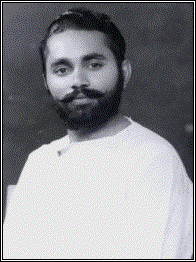 When people heard about Shree Jivanbhai and the ‘Swastik Vyayamshala’, many would come seeking help for all sorts of problems including harassment, marital disputes, health issues and support in times of tragedy and bereavement. Shree Jivanbhai was always willing to help – even if it meant sacrificing his time or putting his life in danger. He had an iron will and was totally fearless. Any difficult situation did not perturb him and his determination was such that he would resolve issues in whatever manner he could. One such example is the abuse of women and children. He was totally against the abuse of women and children by men and would respond with rage. Many suffering women used to turn to him as a last resort and Shree Jivanbhai would go and speak to the culprits. When polite communication did not work and when his patience ran out, he would resort to a physical approach. Often he would put the fear of ‘God’ into them and such a rude awakening often resolved the issue. Dishing out punishment to some of the guilty saved their marriages from falling apart. Many started to follow the straight and narrow path just out of fear of a reoccurrence of the scenario. When people heard about Shree Jivanbhai and the ‘Swastik Vyayamshala’, many would come seeking help for all sorts of problems including harassment, marital disputes, health issues and support in times of tragedy and bereavement. Shree Jivanbhai was always willing to help – even if it meant sacrificing his time or putting his life in danger. He had an iron will and was totally fearless. Any difficult situation did not perturb him and his determination was such that he would resolve issues in whatever manner he could. One such example is the abuse of women and children. He was totally against the abuse of women and children by men and would respond with rage. Many suffering women used to turn to him as a last resort and Shree Jivanbhai would go and speak to the culprits. When polite communication did not work and when his patience ran out, he would resort to a physical approach. Often he would put the fear of ‘God’ into them and such a rude awakening often resolved the issue. Dishing out punishment to some of the guilty saved their marriages from falling apart. Many started to follow the straight and narrow path just out of fear of a reoccurrence of the scenario.
 When Shree Jivanbhai answered a knock on the door in the middle of the night, a mother weeping due to a double tragedy in her family confronted him. Both her sons had drowned while swimming at the ‘Ruieru Falls’ – notorious for undercurrents in the water and immense depth. The family had been searching for Shree Jivanbhai for hours as nobody would go into the water including the Police. As it got dark, there was the danger of wildlife eating up the bodies. The distraught mother wanted to see their faces for one more time and to give them a decent cremation and begged Shree Jivanbhai to help. Shree Jivanbhai was a frequent diver at the falls and was noted for his bravery, as he would dive off the highest point. He was also an excellent swimmer too. Listening to the weeping pleas of the mother was unbearable for him and he agreed to dive in the middle of the night to retrieve the bodies. People on the surface shone bright torches and Shree Jivanbhai dived from the highest point in order to go as deep as possible. He would stay submerged for a long time working his way through the rocks and the undergrowth and basically feeling his way through different areas. Each time he surfaced, he had to climb to the highest point to deep dive again and this he had to do several times. The waters were infested with snakes and wildlife but he had faith in his God of strength – ‘Hanuman Dada – Pavan Sut Hanuman’ and each time he dived, he called out to him for his help and protection. When Shree Jivanbhai answered a knock on the door in the middle of the night, a mother weeping due to a double tragedy in her family confronted him. Both her sons had drowned while swimming at the ‘Ruieru Falls’ – notorious for undercurrents in the water and immense depth. The family had been searching for Shree Jivanbhai for hours as nobody would go into the water including the Police. As it got dark, there was the danger of wildlife eating up the bodies. The distraught mother wanted to see their faces for one more time and to give them a decent cremation and begged Shree Jivanbhai to help. Shree Jivanbhai was a frequent diver at the falls and was noted for his bravery, as he would dive off the highest point. He was also an excellent swimmer too. Listening to the weeping pleas of the mother was unbearable for him and he agreed to dive in the middle of the night to retrieve the bodies. People on the surface shone bright torches and Shree Jivanbhai dived from the highest point in order to go as deep as possible. He would stay submerged for a long time working his way through the rocks and the undergrowth and basically feeling his way through different areas. Each time he surfaced, he had to climb to the highest point to deep dive again and this he had to do several times. The waters were infested with snakes and wildlife but he had faith in his God of strength – ‘Hanuman Dada – Pavan Sut Hanuman’ and each time he dived, he called out to him for his help and protection.
|
  Aum
Hum Pavananandanay Namaha Aum
Hum Pavananandanay Namaha
Feeling his way through the undergrowth, he touched something very hairy and soft – was it a reptile? Or a human head? He grabbed the hair and swam to the surface. The body was fortunately still intact and pandemonium broke out at the surface as people saw the cadaver. Shree Jivanbhai started diving all over again but this time he knew the point where the tragedy had occurred. Very soon he emerged with the second body. Observers pulled the cadaver and Shree Jivanbhai out of the water. The parents of the drowned could not thank him enough afterwards and wanted to reward him with substantial amount of money. Shree Jivanbhai refused any such gifts but told them to pray for him that he may continue to help the poor, needy and the helpless. This incident showed that he had no worries about his safety in time of need. He was awarded a ‘Service to Humanity’ medal by the local community for such bravery and service to the people in need.
Trapeze artist
Shree Jivanbhai’s friend circle started to expand rapidly and soon he got to know many people. One special friendship he forged was with Mr Rooplal Chada and this friendship was to extend to other family members including his ‘brothers-in- law’, the Kapoors. Soon Shree Jivanbhai got to know the Kapoors’ who too were into sports, bodybuilding and acrobatics. It did not take the Kapoors’ long to persuade Shree Jivanbhai to join the troupe and that he did willingly. In a short time, he became a key member and ‘strong man’ of the Trapeze artist team of Manohar Kapoor and Kundanlal Chadha. They started to perform regularly to packed audience without any safety nets.
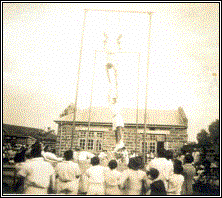 They were fearless and perfectionists and only then they could carry out the high aerial acrobatics. Shree Jivanbhai had a charismatic personality with an ability to captivate the audience. He felt good and ‘at the top of the World’ in such an environment. The friendship grew into a brotherly relationships with all the Kapoors - Manohar, Harkrishanlal, Ompuri, Roshanlal and the Chadhas especially Shree Rooplal Chadha. This ‘Brotherhood’ and friendships were to last his lifetime. They were fearless and perfectionists and only then they could carry out the high aerial acrobatics. Shree Jivanbhai had a charismatic personality with an ability to captivate the audience. He felt good and ‘at the top of the World’ in such an environment. The friendship grew into a brotherly relationships with all the Kapoors - Manohar, Harkrishanlal, Ompuri, Roshanlal and the Chadhas especially Shree Rooplal Chadha. This ‘Brotherhood’ and friendships were to last his lifetime.
 With hand-made apparatus and a will of iron and a heart of steel, Shree Jivanbhai enjoyed Gymnastics to the full. He was 80 years ahead of his time and only now one sees these feats performed in modern day Olympics and International games. The only difference is and was that they learnt, trained, practised and entertained many without any special equipment, aids, help or any financial reward. It was a labour of love, raw strength, determination and a desire to be good and do good! With hand-made apparatus and a will of iron and a heart of steel, Shree Jivanbhai enjoyed Gymnastics to the full. He was 80 years ahead of his time and only now one sees these feats performed in modern day Olympics and International games. The only difference is and was that they learnt, trained, practised and entertained many without any special equipment, aids, help or any financial reward. It was a labour of love, raw strength, determination and a desire to be good and do good!
|
|
|

|
|

|
|
|
He was a perfectionist and practiced till it all came perfect. They performed without nets and without a care in the World about their own safety - to enjoy, entertain and surpass themselves.
‘Forced Conscription and ‘Conscientious Objector’
The Second World War (1940 – 1944) started in Europe and the colonies were ideal recruiting grounds for ‘cannon fodder’. ‘Call up’ papers arrived for Shree Jivanbhai who at once sent them back saying that he was already focussing on two struggles without having to add a third one to his list. By this he meant that he was involved with the Freedom Struggle for the ‘Mother Land - Bharat Mata’ and also that he was involved with the Freedom Struggle in Kenya where thousands of Kikuyu people had been displaced from their land and hundreds imprisoned for protesting. Once again the atrocities were horrendous and this made Shree Jivanbhai’s blood boil. Aircrafts blanket-bombed the forests of Kenya and houses, caves, water wells and crop silos were blown up. Torture was very commons and thousands were rounded up and put behind the barbwires – ‘Internment without trial’ was the answer to any protests and several concentration camps were set up around Nairobi. It wasn’t long before the military police came to collect Shree Jivanbhai. He knew this would happen and while they were trying to unblock the entrance, he jumped out of the back window and escaped into the jungle where he had hidden his motor cycle and a survival kit – a piece of tarpaulin, some dry fruits and ‘Bhagwat Gita’.

The Majestic Rift Valley with surrounding forests and Lake Kikuyu nearby
|
|
‘Mau Mau’
Shree Jivanbhai spent a long period hiding in the forests of the Rift Valley from British Troops. While in the forest, he met several Kikuyu freedom fighters who initially mistook him for a spy but soon one of their scout recognised him as the ‘daring Muhindi’ (‘daring Indian’) who was a frequent diver at the cliffs of ‘Ruieru Falls’. He had seen him in action and was certain that he was neither a spy nor an informer. Shree Jivanbhai explained his predicament and they were happy to help him and took him to their hideout, which was near Lake Kikuyu - a lake, which was covered with a blanket of grass and one could walk on it. It was a favourite hiding place for the ‘Mau Mau’ and when they were pursued, they would dive underneath the grass surface and disappear into the water - a highly hazardous solution - but then one did not have a choice. The British Army used to machinegun the surface often when they lost somebody they were chasing.
Sitting in a huddle in the evening, they would discuss their struggles and the Kikuyus found it very strange and difficult to understand how Shree Jivanbhai could be involved in a ‘non-violent’ struggle and were fascinated by how the Indian struggle was organised and carried out. The amazing thing was that both the struggles had so many commonalities but just different approaches. Shree Jivanbhai used to tell the Kikuyus stories about India which used to fascinate them and also make them laugh. As time went on a strong friendship developed and Shree Jivanbhai was invited to take the Oath, which the ‘Mau Mau’ took. He took the Oath but with a difference in that he believed in their cause and would not betray them in any way, but that he was fighting a similar but a different struggle. This was good enough for them and they presented him with the ceremonial paraphernalia - a spear, a shield, an axe and a club.
Imprisonment
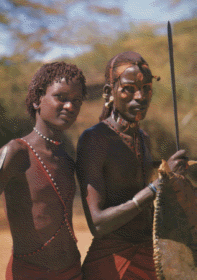 After some time in hiding, Shree Jivanbhai knew that he would have to eventually would have to return. This he did and at once contacted others in a similar situation. His friends had hired a lawyer to fight their case of ‘Conscientious Objection’ to fighting in the Second World War and against ‘forced conscription’. Shree Jivan laughed when he saw the lawyer as he was convinced that he was surely going to loose their case for them and it would mean imprisonment. There was nothing that could be done except to start to practice for the eventuality. This he did by practicing to sleep on the floor and devising ways of occupying himself in confinement. Surely, their lawyer lost the case and they were sentenced to a prison sentence for one year but released after three months for absconding. It was not long before he was able to organise the smuggling of a holy ‘Ramayan’ through his jail keeper whom he befriended. He smuggled it into the prison from friends outside. Shree Jivanbhai intensely studied the ‘Ramayan’ with Amarnath Singh during imprisonment and also reflected on the future to come. After some time in hiding, Shree Jivanbhai knew that he would have to eventually would have to return. This he did and at once contacted others in a similar situation. His friends had hired a lawyer to fight their case of ‘Conscientious Objection’ to fighting in the Second World War and against ‘forced conscription’. Shree Jivan laughed when he saw the lawyer as he was convinced that he was surely going to loose their case for them and it would mean imprisonment. There was nothing that could be done except to start to practice for the eventuality. This he did by practicing to sleep on the floor and devising ways of occupying himself in confinement. Surely, their lawyer lost the case and they were sentenced to a prison sentence for one year but released after three months for absconding. It was not long before he was able to organise the smuggling of a holy ‘Ramayan’ through his jail keeper whom he befriended. He smuggled it into the prison from friends outside. Shree Jivanbhai intensely studied the ‘Ramayan’ with Amarnath Singh during imprisonment and also reflected on the future to come.
VISI - (Indian traditional eating place)
The local restaurant or ‘Visi’ served good traditional meals at a fixed price and the beauty of it was that one could eat as much as one wanted. It had been running for a while and was making a very good profit. Shree Jivanbhai and many of his friends decided to start eating at this local traditional ‘Visi’ and the owner who was also the cook was delighted to have more custom. Usually two curries, rice, dal, a sweet and as many chapattis as one can eat were served. However, exercising and expenditure of energy obviously created hunger and big appetites. Shree Jivanbhai and his friends enjoyed their food and before long the owner found that his profit was dwindling rapidly. It got to a stage where he was making a huge loss while Shree Jivanbhai and his friends enjoyed their food. Hence the owner had no choice but to increase the price per meal and everybody paid the increase willingly. Soon once again the profits started to dwindle and so the price had to be increased again. After several more price increases, the owner begged all of them to leave his ‘Visi’ and to go and eat somewhere else as he realised that he would never make any profit as long as he had cliental such as Shree Jivanbhai and his hungry friends from ‘Swastik Vyayamshala’. This caused a major dilemma as none of them could cook but when it came to meal times, they were always famished.
Cookery lessons were the answer and the first few months were a disaster with dishes turning out to something totally different in taste and appearance. Nothing was wasted and all was eaten. Pots and pans plus plates at each sitting were emptied. Eventually, the standard of cooking improved a hundred percent and all ate happily. Everybody had a tasked and cooking would commence in the morning and by the evening, dinner would be ready to be served. On special occasions, even ‘siro’, dudpak, ladoos and jalebees (different types of Indian sweets) were prepared with great success. Shree Jivanbhai always told everyone at the ‘Swastik Vyayamshala’ to:-
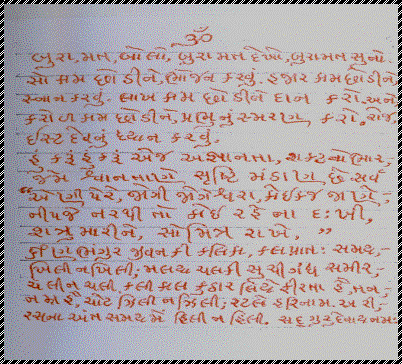
The approximate translation of the above is:-
-
‘Leave your hundred tasks to eat and to eat well’
-
‘Leave your thousand tasks to cleanse yourself by bathing’
-
‘Leave your ten thousand tasks to be charitable by giving food to the poor’
-
‘Leave your hundred thousand tasks to pray to the Almighty’
The ‘Askari Incident’
One day on his way home from the ‘Swastik Vyayamshala’, Shree Jivanbhai came across a six feet Askari (policeman) ‘man-handling’ a weak small Indian gentleman who was found riding his bicycle without lights. It was just getting dark and Shree Jivanbhai tried to explain to the policeman that he was being pedantic and also that he had no right to arrest a fellow brother in that rough manner. He could not bear to see any such injustice and always stood up to protect and defend others regardless of their colour, creed or religion. The policeman paid no heed to what Shree Jivanbhai was saying but instead threatened to arrest him as well. For Shree Jivanbhai, when reasoning failed, he only had one other solution and he went for that. In his possession were chest expanders and he hit the Askari in the face, which floored this giant of a man. As he got up to fight, another blow floored him again. Lying on the floor, he pulled out his whistle and started blowing it and this attracted the attention of several other policemen on duty in Nagara. Soon a manhunt began as Shree Jivanbhai cut across the allotments and the little Indian cycled away into the darkness in the opposite direction.
Shree Jivanbhai was pursued for almost an hour and each time he was caught, he would floor the grappling policeman and carry on running. He eventually reached River Road and saw a long queue of cinemas goers outside ‘Shan Cinema’. He sneaked into the queue as the chasing policemen ran past. With the whole of Nagar district buzzing with policemen, dogs, sirens and whistles, he made his way back home. He knew that in the early morning there would be a ‘house to house’ search and so in the very early morning, he made his way into the city and to a doctor’s surgery. When the surgery opened, he managed to get two back dated sick notes – one for his employer and another for his landlord. He had these delivered while he once again made his escape into the forest of the Rift Valley and back to his Kikuyu friends. They could not stop laughing when he told them the whole episode in great detail and with actions.
As he had guessed, the whole of the area was searched early in the morning and when no one admitted to seeing or knowing the culprit, they were all taken into custody and held for several hours. Solidarity was such that nobody talked and they were eventually released. Detectives were suspicious and knew that there was one daring person who could be their man but were confused when they were shown the sick-note by his employer stating that he was in hospital for the last two weeks – which hospital? Nobody knew! The ‘Daily Standard’ ran headlines on the incident for days and the police were under pressure to find their man who had left seven policemen injured. When the dust settled, Shree Jivanbhai, once again thanked his Kikuyu friends for their hospitality and left for Nairobi with a present from them – a beautifully polished black ebony stick which he treasured and which came very useful on a number of
occasions.
‘Taming the Giant’
On the whole, the Asian Communities are peace loving and hard working communities and sometime this characteristic is detrimental to their cause and attracts trouble. An example of this is when a huge, strongly built, six feet six individual arrived from overseas and at once saw a chance to terrorise and bully the weak and the meek individuals of the community into paying him protection money. When they asked theirs friends and neighbours, none were willing to help them for fear of reprisal and effect on their own business and life. The situation got worse as the individual started to pester their women folk too. Shree Jivanbhai was approached by a couple who had given all their life savings and were now in hiding from this individual. Shree Jivanbhai’s blood boiled on hearing this and went looking for this person.
He found him and after a softly approach, invited him to his place for whisky and a business deal. Of course, Shree Jivanbhai was a teetotaller and the business proposition was to lure this individual into a false sense of security. When he arrived, Shree Jivanbhai seated him and went away to fetch the whisky! He returned not with a bottle of whisky but the ‘polished African Ebony stick’ and before the individual knew any better, laid into him with the stick – blood spurted all over the walls and the attack was so ferocious that this giant of a man was heard howling with fear and pain and desperate to get out of the locked room. He eventually crawled out of the room on all fours and into the darkness. Shree Jivanbhai went back to all the threatened persons and told them what he had done and that he would not trouble them anymore. He also told them to take time out to attend his ‘Swastik Vyayamshala’ where they would meet real, unselfish and brave friends who would stand by anyone who needed help. Soon the story circulated and new members who wanted to become strong and stand on their two feet, joined him. Many were to become ‘life long friends and companions’.
‘Pakhand’ (Pretence)
Shree Jivanbhai was totally against pretence, any mal practice and lies in the name of ‘God or Goddesses’. Often he would see something wrong and would want to put it right. One example is the ‘nine nights of Navratri Festival’ where some individuals, all of a sudden appear to become possessed by holy spirits and start shaking, screaming and more or less bringing the occasion to a stand still. Shree Jivanbhai used to laugh at this and was convinced that any holy spirit would run a mile from many of these unholy and fake individuals! One example he often gave was about a strong man, who, year after year at such festivals would start shouting, screaming and saying that he was possessed by the ‘spirit of Lord Hanuman – the monkey God’. Shree Jivanbhai decided to put this to test and to tackle this person. If he was truly possessed by Lord Hanuman, then Shree Jivanbhai would be flung out of the window by the holy spirit or beaten to a pulp!
One day, he went up to him and put his neck into a wrestling arm lock. Shree Jivanbhai being very strong, managed to restrain this person and the struggle went on for a while. When he tightened the hold further, the individual whispered in agony, ‘You are going to break my neck - please let me go - I promise I will never ever come here again’ and he was never seen anywhere at a public gathering again. Of course, likes of Shree Jivanbhai could only put a wrestling arm lock on fakes who were men but not on fake women! Like many other cultures, we too in our Hindu Culture have things that are wrong, distorted or dramatised. This does not mean that we do not have saints amidst us. Whole society can be taken for a ride by many of these fakes and sometimes no one says or does anything about it for the fear of opening a whole can of worms. Shree Jivanbhai was definitely not one of them to stand silent and ignore it.
Shree Jivanbhai had many stories to tell and people used to gather around him because many were his real life experiences and true. His art of ‘Story Telling’ was always amazing as well as amusing. He used to talk about his experience of the true ‘Bavas’ (holy men) who he had seen in action in India. One used to lift a red hot steel ball the size of a cricket ball and place it into his mouth without any pain or burning. Another was a specialist at making any unholy spirit leave a persons body and this he did by whipping the individual with a red hot steel chain - individual would be heard saying ‘ I am going, I am going …………’. When the spirit was exorcised, the individual was found not to have a single mark or a burn on his or her body. These were the true ‘Bavas’ who possessed true powers and Shree Jivanbhai in his youth observed them. Having lived among them too, he never feared ‘Bhoot or Palit’ (Ghosts or unholy spirits) and since childhood, had a very strong faith in ‘Lord Hanumanji - Pavan Sut Namha’ – the monkey God of strength, truth and loyalty. His faith was so strong that he would call his name - ‘Jay Bajarang Bali’ and step into a situation to defend the truth or the meek, weak and the poor - without any fear or concerns about his own wellbeing.
Eye for an Eye
Shree Jivanbhai had a conflict with some of the teachings of Gandhiji. Although he realised that to drive the British out of India could only be achieved by non-violence, everyday life situations were totally different and requiring different solutions. It was no longer a time for ‘turning the other cheek’. He believed that 'a tooth for a tooth’ and ‘an eye for an eye’ was a necessity; otherwise survival in this ever increasing ‘Violent World’ would be difficult and even dangerous. He agreed that revenge was not condoned in religion but at the same time to defend religion, right or truth, such an action was necessary to secure the well being of men. His desire was that the individual should lead a truthful, religious and loving life. Man should strive to establish truth, piety and love in human society. It was his belief that the power of goodness that comes from such a life could transform the worst power on earth.
But hand in hand with this thinking, Shree Jivanbhai was born a ‘Janooni’ – no one dare take liberty on or of him, his family and friends or for that matter of a fellow Indian going about his everyday life! This aspect repeated itself over and over in his entire life. Even in his old age, this was one point when he would jump up, role up his sleeves and throw down a challenge or go for the throat with his powerful large strong hands without hesitation or
regrets.
Love for parents
Shree Jivanbhai worshipped his parents. His love for them was infinite and he had sad occasions when he had to leave them and ‘Mother India’ in search of a better life. Venturing into the unknown made it difficult to plan anything concrete and life followed the unknown path with its rewards and downside too. One such down side was that he had to spend a large part of his life away from his parents as if destiny had dictated such a sentence. He would travel from Kenya to India to visit them whenever he could and on such visits, he would spend hours talking to them, helping them, making them laugh and making sure they were fine. Viru ma (his mother) used to tell how he used to bath his father, wash his hair, cut his nails, massage his frail body and feed him with love and tenderness.
Nathoo bapa (father) was a very strict and independent person and after some refusals, would allow his favourite son to tend to him. Shree Jivanbhai would also be seen to be washing his parents clothes, tidying their rooms and making them comfortable. On each visit, Viru ma despite her ripe old age, would stay awake all night talking to his son by the fire, reminiscing about the good old days, bad old days, his childhood and the way things had turned out. Shree Jivanbhai would return with wonderful recordings of his parents on a hand held tape recorder and photographs to show his family back in Kenya.
The family in Kenya would gather around the fire after evening meals and sit there for hours listening to his wonderful stories and news about Grandparents, listening to the recordings and discussing the future. The children, despite not being able to visit their Grandparents, had so much love, respect and feelings for the Grandparents as a result of these imported recordings, news, stories and regular blessings from them. Grandparents and parents were and will always remain the ‘umbrellas’ for them and a protection as well as sweet memories and guidance in times of difficulties.
|
|
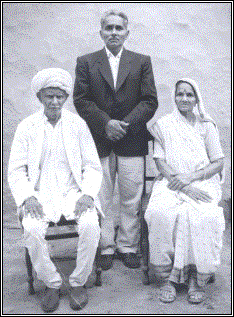
With Mum and Dad
|

Nathoo Bapa and Viru ma
outside the family home
|
|
‘We salute thee, We bow to thee, We prostrate in front of thee’
Shree Jivanbhai’s parents had brought up the children to always respect all people, regardless of caste, colour, creed or beliefs. Coming from a very strict ‘Vashnave’ family, he grew up to also respect all living including insects, plants and animals. He would be seen gently carrying a spider out of the house and setting it free or risking being bitten by a dog from who’s paw he would be seen extracting a thorn. Additionally, even at that period of time, the family believed in equality of sexes and women were treated equally with access to the same privileges as for men. Education was encouraged and Shree Jivanbhai not only fought for these equalities throughout his life but also implemented them in his own family and made sure all his daughters had the best education possible. He sent them all to Universities at a time when this was unheard of in Asian families.
|
|
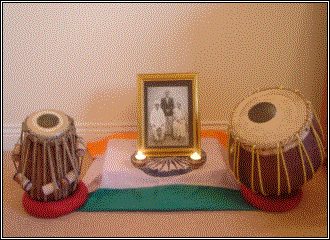 |
|
Untouchables
|
|
|
|
|
Untouchable Issue |
|
In 1932, when Gandhi was behind the bars, an extraordinary event took place. In the name of political reforms, the British Government planned to cut away millions of Indians called 'untouchables' from the Hindu Society. Their principle was to 'Divide and Rule'. In 1924, Gandhiji had fasted for 21 days to bring about Hindu- Muslim unity. He had been saying that un-touch-ability was a shame to Hindu Society. Hinduism should be purged of that guilt. When he saw what the Government was doing, he became unhappy, and decided to fast unto death. There was great commotion in the entire country. The Government realized its folly and gave up the plan. There was an awakening among the people. Government temples, wells and public places were declared open to the untouchables. Gandhiji called the untouchables - 'Harijans' (men dear to God). He started three periodicals 'Harijan Sevak', 'Harijan-Bandhu' and 'Harijan'-all devoted to the service of the Harijans. Shree Jivanbhai took great interest in this struggle and firmly believed in the equality of all religions, casts and creeds - living together in harmony and he endeavoured to support this throughout his life. He established loving relationships with peoples from all walks of life and backgrounds. His ‘Swastik Vyayamshala’ was a typical example of such integration where Hindus, Sikhs, Parsees, Ismalies and Muslims established a ‘Brother Hood’. Later on, he was to meet many Europeans and Africans who too became a part of his life and life long friendships were established.
‘Satyagraha’
In 1941, the Satyagraha struggle took a different shape and Shree Jivanbhai fully immersed himself in this and the Sarvodaya ideology, which was to follow. The first was called the 'Symbolic Satyagraha', and was different from the previous mass Satyagrahas. Only the individuals, whom Gandhiji selected or permitted, had to offer Satyagraha. This change was made because Gandhiji, the Truth-seeker, knew that the past mass Satyagrahas had not been entirely free from violence. Thus he conducted this experiment to make Satyagraha free and free from violence.
In 1942, there came the final struggle for freedom. The call was 'British, Quit India'. For this struggle, Gandhiji gave the inspiring message, 'Do or Die'. Gandhiji expected that the struggle would be purely non-violent. It did not happen that way. Out there was great national upsurge for freedom. Thousands were put into prison. They faced the lathi and the bullet, and gave up their lives. A whole nation rose up against an alien empire. It took all the suffering on itself cheerfully, without a word of demur or hatred or ill will. The way India got her freedom is unique in the history of the world. All the glory of this unique struggle had to go to the great leader
Gandhiji.
The Swaraj or Freedom that Gandhiji dreamed was not m erely of a political character. It was to be a means to create a new man, who would strive to create a new society, a new civilization and a new culture. He called the new social order 'Ramraj' - 'the Kingdom of God on Earth'. Love would be the sole law there. All would be dutiful. There would be no distinction of caste, religion and community. No one would be treated as untouchables. All would be equal in the eyes of religion; all would live by the sweat of their brow. The intellectual worker and the manual worker would be equals; neither could claim superiority. There would be no intoxicating drinks. Women would be honoured. Every one would be ready to give up his life for the good of his country. Gandhiji called such a state of society 'Sarvodaya (The Prosperity of All).
|
|

‘Freedom Struggle and Gandhian Philosophy’
(this photograph was to hang in Shree Jivanbhai’s Study for years, both in Kenya and in UK and still there to present day )
|
|
'Sarvodaya’
(The Prosperity of All)
Shree Jivanbhai believed that to realize Sarvodaya, man has to live with fellow men, with other living beings and nature in order to understand all and to bring harmony. Service to the lowly and the lost in society was Shree Jivanbhai’s first step towards Sarvodaya. Gandhiji had taught him that knowledge and wealth devoid of religion and morals led to the fall of men and this he took to heart and always strived to implement religion in his life.
A leader's responsibilities are high. He has to examine himself severely time and again, to convince himself that he is fit to lead others. He has to bear all the moral responsibility for all that his follower’s do. If he feels unable to do so, he has to retire from the field of action. He has to work to lead this imperfect world in the way of perfection. This is the deathless message that Gandhiji has left us. Shree Jivanbhai took a lot from this piece of advice that Gandhiji had given and in his role as a leader of the ‘Swastik Vyayamshala’, he used to constantly carry out ‘self analysis’ on these
lines.
Teachings of Gandhiji were imprinted in Shree Jivanbhai’s memory and he often took strength from these teachings and sayings. Single-minded devotion to the God of Truth and prayer are lights that Gandhiji has bequeathed to us. He could not remain without prayer even for a single day. 'Silent prayer is my greatest strength' - he used to say. 'Raghupathi Raghava Rajaram,Pathitha Pavana Seetharam.' Whenever we hear this prayer Gandhiji's memory becomes alive. His soul will be present there unseen, and blesses all. It is the task of religion to purify the fallen; it is the power of goodness in man. What does it matter what name we give it? Let us all be blessed with goodness. This is the perennial message that Gandhiji has left to mankind which to this day makes
sense.
Shree Jivanbhai used to often tell stories of Gandhiji and his principles. As a boy Gandhiji was afraid of ghosts and devils. A good nurse, Rambha by name, taught him to repeat the name of Shri Rama to get over this fear. It brought him hope and courage. He chanted it day in and day out. It is significant that, when the assassin shot at him and his body slumped to find eternal rest in the lap of Mother Earth, the last words he uttered were 'Rama', 'Rama'. Mahatma Gandhiji, called 'Bapu' by his loving countrymen, will ever be remembered as a saint and a great leader of men. He died as a martyr in the cause of true religion. One thing for sure – he freed India for the shackles of slavery and dependency by making sure that all Indians learnt to weave cotton. In doing so he was able to destroy imports from UK which were crippling the local Indians and causing a dependency on a foreign power determined to stay for ever. Shree Jivanbhai always gave this as an example and urged his family to be independent of similar shackles of society. To him simplicity was the essence of good life! Gandiji made whole of India and Indians make cloth from cotton so as to abolish the imports from overseas – it worked!

‘Every person should be able to weave cotton’ |
|
Eldoret Arya Samaj shows
Shree Jivanbhai performed
‘Strong Man Shows’ at the ‘Araya Samaj’, Eldoret to packed crowds. Chiselling of a two-inch iron rod on an anvil on his chest was one of his acts. Sledgehammer blows thrown by a volunteer would land on the iron piece on the anvil on his chest till it was cut into two. He also demonstrated physical strength by lifting weights with his teeth. These were plates strung on a rope and lifted clear off the ground.
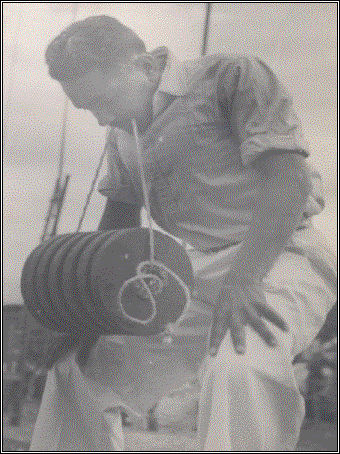
Shree Jivanbhai also performed acrobatic acts requiring total balance, concentration and agility. Another of his act was undressing and dressing while balancing on a plank placed on a large glass bottle. He won several trophies over the years but never displayed them or talked about them. It was never in his nature to make a big thing about these material possessions – he appreciated the true values of life and remained an upright character full of self-confidence all throughout his life. He moulded his character through self- criticism and this was his deep strength.
|
|

|
|
|
Women Of the World |
|
Respect for Women
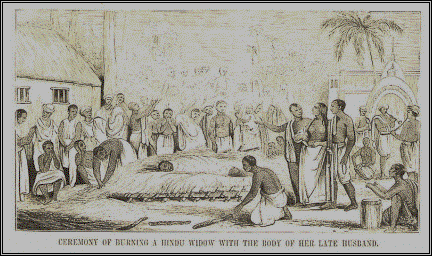
Shree Jivanbhai’s parents brought him up to respect the young, the old, the infirm and the underprivileged. There was always equality in the household as far as sexes were concerned. However, as Shree Jivanbhai was growing up, he could not help noticing that all around him was a male dominated society and that women were not treated equally. As time went on, he could see the injustices very clearly in all aspects of life. The ‘eye – opener’ came one day when he was travelling and came across a lot of noise, drums beating and musical instruments bellowing out the most unholy notes and noises. On investigation, he saw something that was to remain with him for the rest of his life and which made him want to defend, support and respect the female spices as equal at any cost. What he had encountered was the ‘Sati’ or Su-thi or the Suttee - traditional Hindu practice of a widow immolating herself on her husband's funeral pyre. "Sati" means a virtuous woman. A woman who dies burning herself on her husbands funeral fire was considered most virtuous, and was believed to directly go to heaven, redeeming all the forefathers rotting in hell, by this "meritorious" act.
|
|
 |
|
Woman being lead to her husband’s pyre
The woman who committed Sati was worshipped as a Goddess, and temples were built in her memory. However, what he saw here was a young bride hardly nineteen years of age being taken to the pyre. Not afraid of anything, he went as near to the weeping woman as he could and what he saw was totally different to what was being made out to be. Yes, the woman was weeping, crying and hysteric - but not because she was grieving a loss of a husband but because she did not want to die! Yet the noise, the drum beats, the musical instruments and the crowds created such a confusion and a diversion that it appeared as if this poor woman was desperate to jump on the burning pyre of her husband. The holy men did their duty very well and before long the woman was engulfed in flames. Shree Jivanbhai cried all night and could not believe that such practices went on in his beautiful ‘mother land’. This was more like suicide or murder and was against the Shastras, the Hindu code of conduct. He believed that they were coerced, although in the distant past, several wives were know to committee suicide for the fear of being a slave to a society or a family that brutalised women once the husband and her defender passed away. The majority of the widows did not undergo Sati. In the olden days, women were know to have died to protect their honour from the invading enemies after their men perished in the battlefield. But here was a total injustice because the society or ‘in-laws’ belived that a single woman may turn to ill repute once the husband was no longer there or lay claims to his
legacy!
 Indian leader Rajaram Mohan Roy, through his organization ‘Brahmo Samaj’ was among the first who fought to eliminate Sati. The British Government banned the ritual of sati in 1829. However, it took large-scale social reforms by Dayanand Saraswati of Arya Samaj, Mahatma Gandhi and the like to actually stop the practice. Shree Jivanbhai too vowed to fight for women’s rights and to protect and defend them at all cost and this he did throughout his life. His blood would boil if he heard or saw a man hit a woman. He would at once tackle the man screaming, ‘Try hitting a moustached man and see the outcome instead of hitting a wife, sister, mother or a daughter’ – and the outcome would normally be that the assailant would be floored with such a ferocity of blows that he would remember the lesson for the rest of his
life. Indian leader Rajaram Mohan Roy, through his organization ‘Brahmo Samaj’ was among the first who fought to eliminate Sati. The British Government banned the ritual of sati in 1829. However, it took large-scale social reforms by Dayanand Saraswati of Arya Samaj, Mahatma Gandhi and the like to actually stop the practice. Shree Jivanbhai too vowed to fight for women’s rights and to protect and defend them at all cost and this he did throughout his life. His blood would boil if he heard or saw a man hit a woman. He would at once tackle the man screaming, ‘Try hitting a moustached man and see the outcome instead of hitting a wife, sister, mother or a daughter’ – and the outcome would normally be that the assailant would be floored with such a ferocity of blows that he would remember the lesson for the rest of his
life.
Shree Jivanbhai celebrated the Independence of India with great joy when the time arrived. During that time, he also actively participated in the protection of women and children during the partition of India when violent attacks were taking place in Nairobi. He taught women to look after them selves and regular ‘Self Defence Classes’ were held at the ‘Svastic Vayayamsala.’ He was honoured by the ‘Patriotic Front’ for the protection of women and children and awarded a side firearm
(Mauser 3.3 automatic). The gun was a useful companion during the difficult ‘Mau Mau’ period and fortunately he never had to fire it - just the sight of it was sufficient to diffuse many a situation.
Kenya Independence and a different ‘Tri-colour’ |
|

|

|
|
Three major and equal width stripes of black, red and green colours running from top to bottom and separated by narrow white stripes, with a symmetrical shield and white spears superimposed centrally made up the wonderful flag of Kenya. The colour -
Black represents the people of Kenya. Red represents the blood shed in the fight for independence.
Green represents the fertility of the land. White represents peace. The
shield of the warrior represents Kenya's pride and tradition. This too was a ‘Freedom Fight’ in which Shree Jivanbhai
took an interest and what a wonderful occasion it was when on 12th December 1963, this flag was raised and the fire works were set off. Unfortunately, it also heralded a new uncertainty as regards the future of the non-blacks. Until a thinking leader was in power, nothing would happen to the unity of the country. Shree Jivanbhai was a forward thinking person and he could
foresee that future would be a troubled future and he at once started to plan the next move for him and his family!
|
|

Mazee Jomo Kenyatta
|
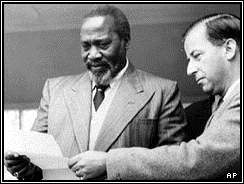
Leader in action
|
|

‘Thinking’ leaders of Africa
|
|
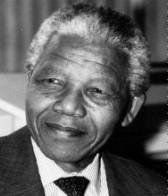
Hero
|

True Freedom Fighter
|
|
‘Salute the hero of today’ is what
Shree Jivanbhai would say and he would talk fondly of Nelson Mandela and the hardship he faced. There were several others who never made it into the history books of today, who too were real ‘freedom Fighters’. Thousands were executed by the Apartheid regime – a price paid so that our future generation can remain unshackled and free!
Radio – ‘All India News’
Standing by the window and brushing his teeth, he would be seen twiddling the knobs on his prize possession – the largest Philips Radio in the whole of Eldoret. Built with a wonderful case of veneered mahogany and housing the combination of valves, diodes and transistors, it stood glimmering on the shelf. In the days of no television, radios were the only means of getting news and information. Shree Jivanbhai was determined to buy the best radio so that he could keep in touch with his ‘Mother Land’, his culture, music, news, Bhajans and songs. There were special programs and special times when the radio would be switched on and often people would gather around it to share his hobby and interest. Despite being a valve radio, the reception was incredibly good and clear. Neighbours often asked him to turn the radio on a bit louder so that they too could enjoy the songs or various programs. Listening to the radio brought him much joy as well as updated him not only on what was happening in India but also around the world.
There were tense times when Shree Jivanbhai would be seen glued to the radio and this was during the India – China war and the several India – Pakistan wars. He would make note of the number of aeroplanes that were brought down and the number lost on either side. He was always saddened to hear about the losses in terms of lives – both civilians and soldiers and Shree Jivanbhai would stand to silence for a few minutes each day when the ‘National Anthem, was played. He did not condone war but always felt that any oppression or injustice had to be met and met with double the force to protect one’s sovereignty and independence. He would be heard saying, ’Let us not let the World see us as weak! They may think that we will always turn the other cheek - if we do turn the other cheek, they will willingly take our head off!
Listening to the radio taught him a lot about the World and what Internet is to us today, radio was to him in the early days. By listening to different stations and broadcasts from America, UK (BBC World News), Japan, Germany and various others, he was able to glean the truth from the propaganda. He always believed in facts and reality and left fiction and fantasy to others.
His pride and joy - ‘the radio’ was the first thing he loving packaged as part of his possessions to take to UK when he moved from Kenya. Even when the Black and White television arrived in the 1960’s, he still preferred the radio or reading the newspapers. Besides reading the English newspapers, he also regularly subscribed to ‘Gurvi Gujarat’ and he would be seen highlighting articles with a pen to show others as well as for future reference. He had a very inquisitive mind as well as a very good memory and an ability to memorise things. This ability was to last him his lifetime.
Ready to sacrifice his life
One early morning whilst exercising, Shree Jivanbhai were to hear screams and shouts for help. At once his instinct was to help whoever was in trouble without any regards to his own safety. As he jumped over a fence and saw a fellow Asian being attacked by three black assailants and he at once grappled with them and soon managed to overpower them. At this moment, four other blacks jumped out of the bushes with knives and started to attack him. He suffered 20 stab wounds and was left for dead. Other members of the ‘Swastik Vyayamshala’ who had also heard the screams arrived to find Shree Jivanbhai bleeding profusely and with his stomach slit open and the intestines all out and all over the place. They all rallied around him and rushed him to the only hospital in Nairobi. This hospital was a ‘Whites Only’ hospital and he was refused entry. By this time more than fifty members of the ‘Swastik Vyayamshala’ who had heard the news arrived and threatened to not only smash up the place but also beat up the doctors and staff if Shree Jivanbhai was not attended to. This threat worked and soon doctors were at work. Specialists were summoned by telephone and queue of people formed to donate blood. After several hours of surgery, he was left to recover and the doctors did not think he would survive. After several hours, he was pronounced dead and a death certificate was signed. A nurse was given the duty of taking him to the mortuary and tidying up the bed. It was while all this was happening when Shree Jivanbhai went through the ‘out of body experience’. He recalled that his soul was escorted out of his body by two pretty serious looking ‘business like’ individuals. They took him by the arms and after flying for a while, reached a huge gate. He remembered some confusion and the Commander at the gate refused them entry. So once again he was escorted to another destination and once again another Commanded after having gone through his list told them that that they had brought the wrong person and that they must take him back. It was in Shree Jivanbhai’s nature to laugh and joke and he did just that with the two. He asked them if they could read and write and if reading had been the cause of the error and he distinctly remembers both not even smiling or frowning! He also remembered asking them if there were any ‘job – vacancies’ as he was on the look-out for a better job! He only got a dry smile. Soon they arrived back at the hospital and he could see his body on the bed and the nurse merrily getting it ready for the mortuary. They made their very brief apologies and dropped him from a height and he remembered landing on the bed with a thud! The impact scared the life out of the nurse who ran out of the room screaming! Shree Jivanbhai’s number had not come up as yet and it was probably a mistake or that as he would put it, ‘blessings from his elders that saved his life’. He went on to live a second phase of life – a ‘family’ life. The Death Certificate was never found by anybody including the Doctor who wrote it. The nurse was so scared that she gave up nursing for good. As for Shree Jivanbhai - he went on to recover to full fitness and a renewed determination to live a better and a fuller life.
Later, he was commended for Bravery and awarded
a Rifle (8x60 - 8mm) by the Commissioner of Police, Nairobi, Kenya – an item, presence of which helped resolve many issues without ever having to use it. He would be seen polishing it with love and tender care or carrying out target practice in the forests with his friends Omi and Manohar Kapoor.
Shree Jivanbhai went on to marry a beautiful lady of his choice –
Shreemati Radhadevi – daughter of Virji Naran Pankhania and Lakiben. Wedding was held on
10th June 1950 at Navagam, Saurastra, India. He worshipped her and lived a very full and loving life till the end. The family was brought up on a combination of discipline, love, care as well as an insight into the future. Education, mannerism, principles, health, religion and service to humanity was the diet on which he brought his children up and despite changing times and countries, he endeavoured to bring them up as best as he could.
Shree Jivanbhai was always interested in everybody he met and everybody he knew. He would make time to ask them how they were, smile and even share a joke with them. With his and brothers’ daughters’, he was even more caring and loving and would be seen stroking their head or holding their hands. With a soft and loving voice, he would give them courage, advice, help and encouragement and at family functions, they would be seen to flock around him with delight in their eyes and well wishes for Bapa, Kaka or Jivanbhai! Laughter would be heard and often tears of love would flow!
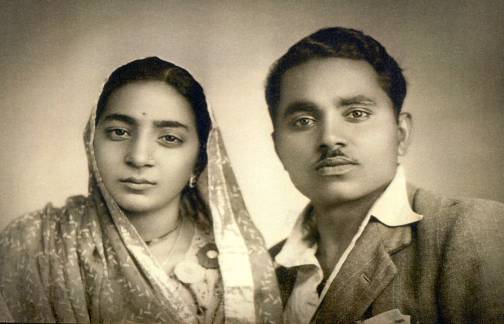
THE HAPPY COUPLE
Massage and Advice for free
Shree Jivanbhai learnt the art of ‘Massage’ in India taught according to the natural laws of human anatomy and energy flow. He was aware that regular massage vibrated and energized the skin, muscles and nerves simultaneously and helped the body become light, active and full of
vitality. Body heat and vitality increased as the heart and circulatory system opened up to provide fresh oxygen and energy to all parts of the system while simultaneously flushing out waste gases and chemical toxins. |
|
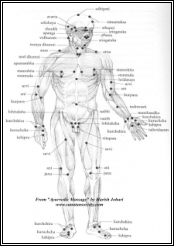
|

|
|
MUSCLES, TENDONS, LIGAMENTS, VEINS AND ARTERIES |
|
Ancient Indian scriptures which deal with health and massage say: "diseases do not go near one who massages his feet before sleeping, just as snakes do not approach eagles." In India one can find people massage people on beaches, on banks of rivers and in market-places - apart from the privacy of homes and wrestling places. Shree Jivanbhai used massage extensively before a wrestling bout and before any gymnastic or bodybuilding events. This helped him to avoid injuries and at the same time toned the muscles and loosen the tendons.
The suffering of people around him always humbled Shree Jivanbhai. He devoted quality time to helping anybody in pain, misery and ill health. Many people used to come to him for advice and treatment and he treated many handicapped and paralysis sufferers by giving them free body massages, physiotherapy and moral support. He also advised them on a balanced diet as well as informed them of various ‘Ayurvedic Medicines’. His ‘Motto’ was to support the weak, the meek and the poor and his essence or ‘lux’ (aim) of life was ‘Simplicity’. He lived a very simple life in the service of humanity.
IDENTITY AND DESCENDENCY
In the 1800’s Shree Jivanbhai’s forefathers lived in a small village called Gadachar which was situated very near Junaghdh, Gujarat in the Saurastra Province of India.
Gadachar was the village of Darbar Chudasma (also known as King Chudasma) and hence he was the descendant of Darbar Chudasma - a royal prince and defender of little kingdoms around Junaghdh. They used to ride horses and incredible as it may seem, used to get married on horses. The community was constantly faced with attacks from wandering looters, invaders and kingdoms from around who were always attempting to incorporate the little kingdoms into their own. However, they held out and defended their rights under Darbar Chudasama. Hence he was a Rajvadu or descendant of the ‘defender of the rights’ and truly a ‘Shatriya’(warrior). The title given to him by his father for his bravery was hence right and fitting.
At one stage the situation was so bad and attacks from outside so heavy that it was decreed that the bridegroom would not go to his marriage with the marriage party but his horse and sword would be sent ahead instead. The priest would perform the wedding ceremony for the ‘Sword’ and the bride. The bride and the best man carrying the ‘Sword’ went around the holy fire four times according to the Hindu tradition. Ambushes were common and attempts to carry away the bride were often made and hence the wedding parties were really a fighting force on full alert and with only one mission - to get the bride and party home safely and before nightfall!
On the demise of Darbar Chudasama, the whole community fell apart. The situation was not helped by the failure of the monsoons and ferocious attacks from outside. Rather than get incorporated into other casts, a group decided to move away and the only thing they took with them was the name of their village – ‘Gadachar’. Their priority was to find a place with plenty of water and good farming soil in order to survive. Their search took them to a tiny place where there was a ‘Vav’ or ‘water well’ belonging to a Royal - Rana Shaib. Hence, the village eventually came to be called Ranavav or the ‘water well of Rana’ and the community from ‘Gadachar’ was established here in 1832.
|
|
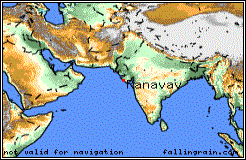
Rananvav
|

Porbandar -the port
|
|
As time went on the surname ‘Gadachar’ was adopted and the occupation changed from ‘defenders of rights’ to ‘farmers’ but they still called themselves ‘Prajapati’ or ‘Guardians of the people’. Over the period, the surname eventually got shortened to ‘Gadhar’. Under the British Raj, it was further corrupted to all sorts including Gardener, Gadner and Gadher. Most now have the unusually spelt surname of
Gadher but pronounced Gatheir. So Shree Jivanbhai was born as a Gadher and displayed his true characteristics of ‘the defender of rights’. All his characteristics were truly of the past including being strong, brave, unselfish, prepared to sacrifice his life for the good of the community, knowledge of warfare, natural ability to ride horses, agility with the sword and totally fearless. The saying, ‘It is in the blood’ was totally true and justified for Shree Jivanbhai.
Charities and Principles
Shree Jivanbhai undertook ‘Charity Walks’ and organised fund-raising events to collect sponsor money for Humanitarian Causes such as Famine Relief in Somalia, Ethiopia, Bangladesh and India. Daughter Hemlata was his constant companion and support on such projects. They would spent hours counting the collection coins and organising the next event. Despite his age, he would out-walk the younger ones and still have energy to play jokes on them as they arrived huffed and puffed!
Shree Jivanbhai distributed food to the needy and destitute and set up the
‘Food for now and Always Program’ at Shanti Bhavan, Kerela, South India - now an ‘on-going’ charity. He also financed
‘Food Aid’ for the ill and the needy at the ‘Mental Health Centre’, Trivandrum, South India - now an ‘on-going’ support. Besides this, whenever the opportunity arose, he would fulfil his ‘mun kamnaos’ (wishes) such as ‘shadu Bhojan’ (feeding the holy men and women and young Brahmcharis) and dan (feeding the ill, poor, mentally disable but able bodies, and disabled) with his own hands. He, also according to Hindu religion would feed the animals (cows) and birds whenever he could. But most important of all such actions was to make time and feed the potentially divine soul(s) that would knock on his door. He always offered them food and drinks and welcomed them with open arms. He would be heard saying, ‘Today I had ‘Maheman’ (very special divine souls) and I fed them with love and that they left with a full stomach’. This was one of the principles of the house and there was always more than enough food to accommodate as many visitors at any time!
Chain of Gurus
After years of searching and waiting, Shree Jivanbhai achieved his wish for a ‘Guru’. He was granted ‘Guru Daxhina’ (acceptance as a disciple) by Shankracharya Maharaj – Swami Satyamitranand Giriji on his visit to Eldoret, Kenya in 1960. This was a major turning point in his life and he turned his attention to the teachings of ‘Bhagavat Gita’. ‘Krishna Bhajan’ became his priority and regular prayers, mala (rosary beads), meditation, fasting and reading became a routine. He would get up at 5am in the morning every single day and spend significant time in prayers before the World woke up. This was true in the evening at Sandhya (before sunset). He lived a peaceful and happy life and as usual, simplicity was essence of life for him.
|
|

|

|
|
SwamiSatyamitranand Giriji |
Shree Jivanbhai not only drew sustenance from his Guru
Jagadguru Shankracharya Maharaj – Swami Satyamitranand Giriji but also from his Guru’s Gurus. His chain of Gurus and their teachings, knowledge and blessings was infinite, intriguing and amazing. The chain was as follows
\ |
|
Jagadguru Shankracharya Maharaj – Swami Satyamitranand Giriji
â
Swami Vadum Vayas Ananda (Swami Satyamitranand Giriji’s Guru)
â
Swami Vivekananda Maharaj
â
Swami Ramakrishna Paramhansa (Swami Vivekananda’s Guru)
â
Swami Tirth Maharaj
â
Swami Adi Shankracharya Maharaj
â
Gow - Swami Tulshidas Maharaj
â
Janum Guru Nathoo Bapa Jadav Gadher
|
|
|
|
|
The above chain of Gurus was awesome, colourful, deep, defined and powerful and kept Shree Jivanbhai busy trying to understand, learn, memorise and associate with their thinking and teachings. He also was an avid reader and studied ancient history and the great man of the time including Gavtam Buddha, Chhatrapati Shivaji Maraj, Maharana Pratap, Lokmanya Bal Gangadhar Tilak, Kabir Das, Guru Gobind Singh and Madamecama
|
|

Guru Gobind Singh
|
Madamecama
|

Shivaji Maharaj
|
|
|
This together with the modern day ideologies of Mahatma Gandhiji, Sardar Vallab bhai Patel, Netaji Subhash Chandra Boss, Dr RadhaKrishnan, Rabindranath Tagore, Jawaharlal Nehru, Lal Bahadur Shastri, Martin Luther King, Nelson Mandela and recently, Dr Abdul Pakir Jainulabaddin Abdual Kalam, expanded, occupied and even to a certain degree moulded Shree Jivanbhai’s character, understanding and outlook. He was a wealth of knowledge and a source of information. But above all, he put into practice what he had learnt, what he believed to be right - to make his and his family’s life better, exciting and
correct.
|
|
Sardar Vallabbhai Patel
|
Subhash Chandra Boss
|
Bal Gangadhar Tilak
|
|
|
Krishna Nivas, Friford
Shree Jivanbhai enjoyed his stay and holidays at
‘Krishna Nivas’, Frilford, Oxfordshire with families and friends. He enjoyed walking through the orchards and vegetable fields, listening to shrills of the peacock and the singing of the birds. He loved visiting the nearby stream on the farm and would sit for hours by the flowing water. For him, this depicted everything for him from ‘Ganga Mata’ in Oxfordshire to ‘Vandravan’ at ‘Krishna
Nivas’. He was always ‘at-one’ with nature and reminisced about his days on his father’s farm in
Ranavav, India. Much time and many an hour were spent sitting on the water’s edge discussing life with son Suresh. The place will never be the same now without him but he leaves behind a wonderful atmosphere of love, life, reality and wonderful memories. |
|
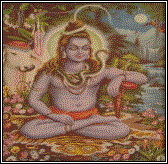
The Lion of Ranavav, Gujarat, with a rock-like will-power was no more. His demise was sudden to others but he was always ready for the call and had fulfilled his aims, wishes and duties.
At the time, he was a fighting fit ‘Eighty Four’ year old who always faced life with a smile on his face and good in his heart.
His name will live forever in history of his community, friend circles, family and the numerous persons that he helped in his life time.
He was the Architect of ‘Swastik Vayamshala’ and changed several peoples lives for the better by helping them kick their bad habits.
He was a wise counsellor in the hour of trial, a trustworthy friend and a ‘mind of courage and inspiration’. He was known as the ‘Man of Steel’. But tenderness was very much alive in the steel of his nature.
He never suffered fools, neither did he try to appease anyone for the sake of it or so that somebody would call him good.
He strongly believed in ‘an eye for an eye’ and a ‘tooth for a tooth’ and would not rest till he had put right the wrong.
His had an incredible and unique mix of values and principles he possessed till his final hour and he never once wavered from them.
He did not believe in making hopeless speeches. In fact, he was a man of very few words. He accepted with a calm mind whatever life brought him, may it be happiness or sorrow. Pain and sorrow could not alter a single line of his face. When necessary he could be dominating; but by nature he was very courteous, polite and a true Gentleman.
It is 84 years since this Hero, the Durbar, was born. Let us remember him with reverence and fondness as there are very few in our community and society who come anywhere near his ideals and achievements. Let us emulate his admirable qualities.

REST IN PEACE IN GOD’S ABODE |
|
|
|
|
|
 |
|
|
|
|