|
1861
Birth of Rabindranath Tagore
In
the late 19th – early 20th
centuries Rabindranath Tagore - celebrated poet
and educator, made significant contributions to
the cause of Indian unity in the cultural
"wars" against British colonialism.
Tagore was born in 1861 during the British
colonial era in India. Through lecturing in
different countries, founding a school (later a
university) in 1901, and writing on social and
political themes, Tagore sought to impart a
greater understanding between Western and
Eastern philosophies, religions, and cultures.
He wrote mostly in Bengali, but translated many
of his own works into English..
1885
Indian National Congress born
1894
Birth of Shree Nathoobhai Jadavbhai Gadher in
Ranavav, India
1897
Plague in Bombay.
Famine Commission was set up
1896
Birth of Shreemati Viruben
future
wife to Shree Nathoobhai Jadav Gadher and mother
to Shree Jivanbhai Nathoobhai Gadher
1899
Lord Curzon becomes Governor – General and
Viceroy to India
1912
Marriage of Shree Nathoobhai Jadavbhai Gadher to
Shreemati Viruben
1913
Meramanbhai Nathoobhai Gadher born
1914
Mohandas Karamchand Gandhi
returns to India from South Africa, where
he had organized the Indian community there to
oppose the white supremacist government through
a technique of non-violent agitation he called
"satyagraha" (trans. "moral
domination").
1914
- 1918
World War I: large
numbers of Indians, Hindu and Muslim, rallied to
the British cause and 1.2 million Indians gave
valiant service to the war effort. However, a
joint campaign of the Indian National Congress
and the Muslim League resumed anti-British
demands for political reforms in 1916. The
British responded with promises of increased
self-government. After the war, however, the
British passed the Rowlatt Acts, suspending
civil rights and enacting martial law in areas
disturbed by riots and uprisings.
1915
Shree Devjibhai Nathoobhai Gadher born
1917
Shree Veljibhai Nathoobhai Gadher born
1918
Shree Ramjibhai Nathoobhai Gadher born
1919
Jalianwalabagh Massacre at Amritsar in the
Punjab, when
British troops fire on a huge assembly of people
protesting British rule.
Sikhs join the Indian freedom struggle,
and Mohandas K. Gandhi, Hindu
social and religious reformer, emerged
as a formidable Indian leader in the
independence movement. Gandhi called upon all
Indian people to meet British repression with Satyagraha—non-violent
resistance. Native outrage at the massacre
provoked widespread violence and disorder,
prompting Gandhi to declare April 13 a day of
mourning. Anti-British feeling intensified.
|
|
1920
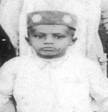
Birth of Shree Jivanbhai Nathoobhai
Gadher in Ranavav, Saurastra, INDIA
|
1920
– 1922
Gandhi
instituted the Non-Cooperation Movement--calling
for boycotts of British commodities, courts, and
educational institutions; non-cooperation in
political life, and renunciation of British
titles held by Indians—which proved very
effective in fight for Indian freedom. Viewed as
seditious, Gandhi was imprisoned in 1922, and
periodically again thereafter over the next two
decades (the last time in 1942). Gandhi was
called Mahatma (Sanskrit for "Great
Soul") among the Indian people.
1924
The communist party of India Organised at Kanpur
New York's Computer
Tabulating Recording Company is re-organized and
will now be known as International Business
Machines Corp. (IBM).
1925
John Baird transmits the first television image
in London.
1926
Robert Goddard fires the first liquid fuel
rocket
Auto antifreeze allows people to use cars
year-round.
1927
Charles Lindbergh makes the first non stop solo
transatlantic flight.
1928
John
Baird beams a television image from England to
the United States.
Alexander Fleming discovers penicillin.
1929
Bhagath singh and his friend threw a bomb In the
Imperial Legislative Assembly
German psychiatrist
Hans Berger develops the electroencephalogram
(EEG) for recording brain waves.
1930
– 1931
Gandhi organized the Civil Disobedience
Movement,
a mass violation of the government salt
monopoly, and led the 200-mile Salt
March to the Gulf of Khambhat where
seawater was boiled to make salt. Gandhi was
again jailed, and the Indian Nationalist
Movement revived, as civil disobedience, riots,
demonstrations, and widespread disorder resulted
in 27,000 Indian nationalists sentenced to
prison terms. Many women also emerged, including
Sarojini Naidu, Aruna Asaf Ali,
and Bhikaji Cama, played an
active role in the struggle for freedom. While
the British reached a truce with Gandhi and
other Indian National Congress leaders, the
Muslim League advanced demands for special
privileges in the proposed Indian dominion
government, professing fear of Hindu domination.
The controversy provoked bitter Hindu-Muslim
rioting and widened the schism between the Indian
National Congress and the Muslim
League.
1930
Jawahar
Lal Nehru hoists the ‘tri-color’ of
Indian Independence on the banks of the river
Ravi at Lahore.
The Congress passes the Civil
Disobedience Movement Bill.
Gandhiji begins Dandi March to
manufacture illegal salt
Vannevar Bush builds
"differential analyzer" - first analog
computer.
1931
Karl Jansky begins the science of radio
astronomy as he observes interference in the
form of hissing sounds coming from beyond the
earth's atmosphere.
Harold Urey discovers heavy water, water that
contains deuterium, a rare hydrogen isotope.
An electron microscope is developed by Vladimir
Zworykin and James Hillier.
1932
Amelia Earhart is first woman to fly Atlantic
solo (May 20-21).
1933
Roosevelt
inaugurated
1934
Hitler becomes Fuhrer when chancellorship and
presidency are united
1935
- 1937
The
British Parliament and then the Indian people,
influenced by Gandhi, approve the Government
of India Act, which prepared the way for full
independence and protection of Muslim
minorities. However, many Indian
National Congress members opposed the act, which
stopped short of full independence for India. In
practice, the plan for federation of India
proved unworkable because Indian princes refused
to cooperate with the more radical Indian
national Congress and Muslims continued to claim
the Hindus had excessive influence on the new
national legislature. The Muslim League,
led by Mohammed Ali Jinnah, advocated the
creation of an independent Muslim state
(Pakistan), which in turn provoked
violent Hindu opposition.
1935
After inventing a
quick, accurate way to measure pH for a friend
in the citrus industry,
Dr. Arnold Beckman launched what is today
Beckman Coulter, Inc.
Du Pont chemist
Wallace Hume Carothers creates nylon, the first
completely synthetic fabric.
Aircraft-detecting radar is pioneered by Robert
Watson-Watt in England.
1936
In Berlin,
dictator Adolf Hitler and his Nazi followers
felt sure that the Olympics would be the ideal
venue to demonstrate Germany's oft-stated racial
superiority. He directed that $25 million be
spent on the finest facilities, the cleanest
streets and the temporary withdrawal of all
outward signs of the state-run anti-Jewish
campaign. By the time over 4,000 athletes from
49 countries arrived for the Games, the stage
was set. Then Owens, a black sharecropper's son
from Alabama, stole the show-winning his three
individual events and adding a fourth gold medal
in the 4x100-meter relay. The fact that four
other American blacks also won did little to
please Herr Hitler, but the applause from the
German crowds, especially for Owens, was
thunderous.
King
George V dies; succeeded by son, Edward VIII,
who soon abdicates to marry an American born
divorcee, and is succeeded by brother, George
VI.
The British Broadcasting Corporation (BBC)
debuts the world's first television service with
three hours of
programming a day.
Alexis
Carrel and Charles Lindbergh develop the first
artificial heart.
The
first successful helicopter flight is made.
1937
The dirigible "Hindenburg" explodes at
Lakehurst, N.J., killing 36 (May 6).
Amelia Earhart and co-pilot Fred Noonan vanish
over the Pacific Ocean on their Round-the- World
Flight
The
Golden Gate Bridge is completed.
1938
Orson Wells broadcasts his adaptation of H.G.
Wells's War of the Worlds, creating a nationwide
panic as listeners believe that aliens have
landed in New Jersey (Oct. 30).
Chester F. Carlson
produces the first xerographic print.
Teflon is developed by Roy J. Plunkett at Du
Pont.
George and Ladislav Biro invent the ballpoint
pen.
1939
– 1945
World
War II rang the death knell for Western
Colonialism in many parts of the world.
In India, the British viceroy declared war on
Germany in 1939, in the name of India, without
consulting Indian leaders. Congress Ministries
in 9 provinces resign resisting Indian support
for the British war effort.
1939
Subash
Chandra Bose resigns the president-ship of the
Congress Party
Germany invades Poland
- World War II begins.
The big-screen adaptation of Gone with the Wind
premieres.
Albert Einstein writes a letter to President
Rooseveitregarding the possibility of using
uranium to initiate a nuclear chain reaction,
the fundamental process behind the atomic bomb.
1940
Gandhi
and other Indian National Congress leaders
intensified their campaign for immediate
self-government, naming it as the price
for Indian cooperation in the war effort, and
were arrested. A campaign of civil disobedience
was launched in 1940, while the Muslim League
and many princely states supported the British
war effort. Again, vast numbers of Indian troops
participated in war on the British side at home
and on the fronts.
Winston Churchill
becomes Britain's Prime Minister
Plasma is discovered to be a substitute for
whole blood in transfusions.
1941
Subhash
Chandra Bose
escapes from India to organize the I.N.A.
(Indian National Army) movement to enlist
support to fight against the British.
Ravindranath
Tagore passes away (1861 – 1941)
Rabindranath
Tagore
won the the Nobel Prize for Literature in 1913
"because of his
profoundly sensitive, fresh and beautiful verse,
by which, with comsummate skill, he has made his
poetic thought, expressed in his own English
words, a part of the literature of the West. "
Tagore
was the first non-Westerner to win the prize. He
translated into English much of his own prose
and verse including Gitanjali:
Song Offerings (1912),
a collection of religious poems that
especially arrested the attention of the
selecting Nobel Prize critics.
Japanese surprise
attack on U.S. fleet at Pearl Harbor brings U.S.
into World War II; U.S. and Britain declare war
on Japan.
Glenn Seaborg and Edwin McMillan isolate
plutonium, a fuel preferable to uranium for
nuclear reactors.
1942
Cripps
Mission:
Waves of anti-British agitation in India,
however, prompted the British to institute the
"Cripps Mission," instituting an
interim government during the war and promising
full independence for India after World War II.
The mission failed when both Congress and Muslim
League leaders objected to various sections of
the proposed program. Quit India Movement
started by Gandhi, resumed the civil
disobedience movement. Indian resistance to rule
of the British Raj intensified; Gandhi, Nehru,
and 1000s of supporters were imprisoned, and the
Indian National Congress was outlawed
Radar comes into
operational use.
Japanese
bombardment of Rangoon. Singapore Falls
Congress
Working committee adopts ‘Quit India
Resolution’
1943
Subhash
Chandra Bose Reaches Tokyo
Selman Waksman
discovers streptomycin and coins the term
antibiotic.
1944
Japanese
invaded India
along the Indian-Burmese border, encouraged by
Indian disunity and anti-British agitation.
After initial successes, the Japanese were
forced back into Burma by Anglo-Indian troops.
The British released Gandhi from jail on May 6;
Gandhi and Muslim leader Jinnah began
negotiations to iron out their differences, but
the discussions ended in failure.
Allies invade Normandy on D-Day (June 6).
DNA is isolated by Oswald Avery.
1945
India
became a charter member of the United Nations,
Nehru was released from prison, and the British
government issued a white paper on the Indian
question, with proposals resembling the Cripps
mission of 1942.
Hitler commits suicide (April 30); Germany
surrenders (May 7); May 8 is declared V-E Day.
US drops atomic bombs on
Japanese cities of Hiroshima (Aug. 6) and
Nagasaki (Aug.8).
1946
A
new deadlock and anti-British riots provoked a
new series of negotiations with Indian leaders
in 1946. An interim government representing all
major political groups except the Muslim League
was established, with the Muslim League finally
agreeing to participate. J. L Nehru is
named Prime Minister of the Interim Government,
formed through the Cabinet Mission’s plan to
prepare India for independence. Nevertheless,
anarchy threatened as Muslim-Hindu
strife escalated in various parts of
India, with widespread communal riots.
The US Army makes radar contact with the moon
for the first time.
1947
Louis
Mountbatten
became viceroy and recommended immediate
partitioning of India to the British government
as the only means of averting catastrophe. The
Indian Independence Act, incorporating
Mountbatten’s recommendations, was speedily
approved by the British parliament, and on
August 15, India and Pakistan were established
as independent dominions of the Commonwealth of
Nations, with the right to withdraw or remain in
the British commonwealth (India elected to
remain in the Commonwealth in 1949.)
The
new states of India and Pakistan were created
along religious lines,
areas with Hindu majorities allocated to India
and those with predominantly Muslim populations
assigned to East and West Pakistan (with 1000
mi. of Indian territory between them).
Dr Rajendra Prasad Becomes the 1st President of
India
The
microwave oven is invented by Percy Spencer
(US).
1947
– 1949
Kashmir
is
attacked by Muslim insurgents, supported by
Afghanistan and Pakistan, after Hindu leader
Raja Hari Singh signs documents to make Kashmir,
traditionally predominantly Muslim, part of
India. Pakistan questioned his right to do so. Fighting
between Muslim and Indian forces broke out and
continued until 1949, with the
intervention of the United Nations. The U.S.
sided with Pakistan and the U.S.S.R. sided with
India in the Kashmiri dispute. Kashmir remains
an unresolved source of troubled relations
between India and Pakistan.
1948
The Mahatma
("Great Soul") Gandhi is assassinated
by a Hindu fanatic. Jinnah, founder of Pakistan,
died later the same year.
George A. Gamow (US) puts forth the "Big
Bang" theory to explain the origin of the
universe.
1949
Ceasefire in
Kashmir declared. Enactment of Indian
constitution takes place
Capt. James Gallagher and USAF crew make first
round-the-world nonstop flight from Ft. Worth,
Texas, and returning to same point: 23,452 miles
in 94 hours, 1 minute (Feb. 27-March 2).
1950
India
becomes Republic
Col. David C. Schilling (USAF) makes the first
nonstop transatlantic jet flight in 10 hours and
1minute (Sept. 22).
The first Xerox machine is produced.
The first self-service elevator is installed by
Otis Elevator in Dallas.
Richard Lawler (US) performs the first
successful kidney transplant at Loyola
University.
1951
Bangladesh (West Pakistan) revolts
against (East) Pakistan, and Indo-Pakistani War
erupts.
UNIVAC (Universal Automatic Computer), the first
business computer to handle both numeric and
alphabetic data, is introduced.
Gregory Pincus, Min Chuch Chang, John Rock, and
Carl Djerassi (US) develop the first oral
contraceptive.
1952
First
general elections; Congress government comes to
power
George VI of England
dies; his daughter becomes Elizabeth II (Feb.
6).
The first plastic artificial heart valve is
developed at Georgetown Medical Center
1953
Mt
Everest conquered for the first time by
Tenzing and Hillary.
Gen.
Dwight D. Eisenhower inaugurated
President of United States (Jan. 20).
Rosalind
Franklin (England), Francis Crick (England), and
James Watson (US) discover the double-helical
structure of DNA
1954
Doctrine of Panch Shila (Five
Principles of Non-Interference) is accepted as
the basis for Indo-Chinese relations.
Roger Bannister -
British runner - first to run mile in less than
4 minutes (3:59.4 on May 6, 1954).
The USS Nautilus, the first atomic submarine, is
commissioned at Groton, Connecticut.
Boeing
tests the 707, the first jet-powered transport
plane.
1955
Churchill resigns (April 5); Anthony Eden
succeeds him (April 6).
Severo
Ochoa at NYU synthesizes DNA- and RNA-like
molecules.
1956
Indian
States are reorganized on linguistic-cultural
bases.
A 2nd Five-Year plan for economic
development is launched. Meanwhile, Pakistan
produced a new constitution and declared itself
an Islamic Republic
Felix
Wankel (Germany) develops the rotary internal
combustion engine.
The
DNA molecule is first photographed.
1957
Russia
launches Sputnik I, first earth-orbiting
satellite-the Space Age begins
1958
First
transatlantic jet passenger service started by
BOAC, with a New York to London route.
1959
The
Lunik II probe (USSR) reaches the moon; Lunik
III photographs the dark side of the moon for
the first time.
1960
First
Summer Olympics (Rome) to be covered by US
television.
Alfred
Hitchcock's Psycho terrifies movie-goers and
becomes one of the year's most successful films.
1961
Portuguese surrender Goa, which
again becomes part of India.
India drives the formation of the Non-Aligned
Movement (NAM):
refusing alignment with either super power in
the "Cold War," India under Nehru
sought close bilateral relations and cooperation
with countries of both the Western and Socialist
blocs, as well as other non-aligned nations of
the world.
East Germany
erects the Berlin Wall between East and West
Berlin to halt flood of refugees.
USSR detonates 50-megaton hydrogen bomb in the
largest man-made explosion in history.
Moscow
announces putting first man in orbit around
earth, Major Yuri A. Gagarin
1962
Lt. Col. John H. Glenn, Jr., is first American
to orbit Earth - three times in 4 hours 55
minutes.
Unimation introduces the first industrial robot.
The
first transatlantic television transmission
occurs via the Telstar Satellite, making
worldwide television and cable networks a
reality
1962
Chinese
Invasion of India in the NEFA & Ladakh
regions. War with China starts
1963
President Kennedy shot and killed in Dallas,
Texas. Lyndon B. Johnson becomes President
1964
Prime
Minister Jawaharlal Nehru dies
Nelson Mandela
sentenced to life imprisonment in South Africa
1965
– 1966
Undeclared
war rages between India and Pakistan,
with India winning some Pakistani territories,
coming very close to Lahore; and Pakistan
winning back some parts of Kashmir. USSR
mediates peace talks between India and Pakistan.
The first US
combat troops arrive in Vietnam
Soviet cosmonaut Aleksei Leonov performs the
first spacewalk (Mar. 18). Edward White II
becomes the first American to walk in space
(June 3).
1966
Jan
11th -
Prime Minister Lal Bahadur Shastri dies
at Indo-Pak summit at Tashkent
Indira Gandhi (1917-1984) becomes
Prime Minister of India.
Unrest
begins in the Punjab, resulting
in its division into Punjabi-speaking Punjab,
and Hindi-speaking Haryana.
Jan
20 - Mrs Indira gandhi Becomes Prime
Minister
World Cup: England
beat West Germany 4-2
MIT biochemist Har Khorana finishes deciphering
the DNA code.
1967
Dr.
Christian N. Barnard and team of South African
surgeons perform world's first successful human
heart transplant (Dec. 3).
1968
Martin Luther
King, Jr., civil rights leader, is slain in
Memphis (April 4).
Senator Robert F.
Kennedy is shot and critically wounded in Los
Angeles hotel after winning
California primary (June 5)-dies June 6.
Prototype of world's first supersonic airliner.
The Soviet-designed Tupolev Tu-144 made its
first flight, Dec. 31. It first achieved
supersonic speed on June 5, 1969.
1969
Apollo 11
astronauts-Neil A. Armstrong and Edwin E. Aldrin,
Jr., take first walk on the Moon (July 20).
The scanning electron
microscope is developed
1970
IBM introduces the
floppy disk.
Bar codes (computer-scanned binary signal code)
are introduced for retail and industrial use in
England.
The LCD (liquid crystal display) is invented by
Hoffmann-La Roche (Switzerland)
1971
Another Indo-Pakistani
War
takes place, resulting in the creation of
Bangladesh (former East Pakistan) as an
independent nation.
Intel introduces the microprocessor.
1972
Simla
agreement signed between Indira Gandhi and
Pakistan’s Prime Minister Zulfikar Ali Bhutto.
Munich Olympics - On Sept. 5, with six days left
in the Games, eight Arab commandos slipped into
the Olympic Village, killed two Israeli team
members and seized nine others as hostages.
Early the next morning, all nine were killed in
a shootout between the terrorists and West
German police at a military airport.
1973
Transmission
Control Protocol/Internet Protocol (TCP/IP) is
designed and in 1983 it becomes the standard for
communicating between computers over the
Internet.
Nuclear Magnetic
Resonance (NMR), the technology behind MRI
scanning, is developed.
Skylab, the first American space station, is
launched (May 14).
1974
Indira
Gandhi pushes science and technology, and India
conducts its first nuclear explosion, justified
as a deterrent to Chinese aggression.
India
becomes the world's sixth nuclear power.
Explodes nuclear device in Pokhran,
Rajasthan
Richard M. Nixon
resigns - is the first US President to do so
(Aug. 8) and Vice President Gerald R. Ford of
Michigan is sworn in as 38th President of the US
(Aug. 9).
1975
First Indian satellite is launched, along with
an ambitious family planning program. Socialism
movement and unrest intensifies, and a State of
Emergency is declared.
Indira
Gandhi found guilty by court of electoral
malpractice; President declares state of
emergency due to "internal disturbance
threat"
Home videotape systems
(VCRs) are developed in Japan
1976
India
and Pakistan re-establish diplomatic relations
at the ambassadorial level
Air France and British
Airways begin the first regularly scheduled
commercial supersonic flights.
1977
Emergency ends in sixth General elections;
Janata Party comes to power
The space shuttle
Enterprise makes its first test glide, from the
back of a 747.
1978
Sony introduces
the Walkman, the first portable stereo.
Louise Brown, the
first test-tube baby, is born.
1979
Janata
Party splits; Seventh general elections held
Conservatives win British election; Margaret
Thatcher becomes new prime minister (May 3).
1980
Indira Gandhi returns to power
Ronald Reagan elected US President (Nov. 4).
John
Lennon of the Beatles shot dead in New York
City.
1981
AIDS is first identified.
IBM introduces its first personal computer, running the Microsoft Disk Operating System
(MS-DOS).
The 236-m.p.h. TGV, Europe's first high-speed passenger train, begins operating out of Lyons, France.
1982 – 1984
Sikh unrest begins and quickly becomes violent, centered at the Golden Temple Complex in
Amritsar. Indira Gandhi sends the Army in to crush the rebellion. The Sikh leader is killed in the assault, and the Sikhs take revenge by assassinating Indira Gandhi. Widespread Hindu-Sikh riots result, and nearly 3,000 Sikhs die. Rajiv Gandhi becomes Prime Minister in his mother’s place.
British overcome Argentina in Falklands war (April 2-June 15)
1983
Sally K. Ride, 32, first US woman astronaut in space as a crew member aboard space shuttle Challenger (June 18).
1984
Oct 31 - Indira Gandhi assassinated; son Rajiv Gandhi becomes Prime Minister
In Bhopal, Union Carbide gas leak kills over 2,200
Apple introduces the user-friendly Macintosh personal computer.
1985 –1988
Sikhs remain emotionally alienated and precipitate further terrorist violence in the Punjab. Meanwhile, Rajiv Gandhi pushes for economic development and high tech industry, consumerism and prices rise, along with public corruption. Relations with U.S., Pakistan, and China improve, while those with Sri Lanka (over Tamil minority rights) and Nepal deteriorate.
1985
With the availability of relatively inexpensive laser printers and computers, tools for desktop publishing begin to be commonly used.
1986
Space shuttle
Challenger explodes after launch at Cape
Canaveral, Fla., killing all seven aboard (Jan.
28).
1987
Richard Branson
and Per Lindstrand make the first transatlantic
hot-air balloon flight. 2,790 miles from
Sugarloaf Mountain, Maine, to Ireland Virgin
Atlantic Flyer (July 2-4).
1988
Pan-Am 747
explodes from terrorist bomb and crashes in
Lockerbie, Scotland, killing all 259 aboard and
11 on ground (Dec. 21).
1989
Rajiv
Gandhi's Congress defeated in ninth general
elections; minority government led by Janata
Dal's V.P Singh comes to power
After 28 years, Berlin Wall is open to West
(Nov. 11).
First World Wide Web server and browser
developed by Tim Berners-Lee (England) while
working at CERN.
1990
South
Africa frees Nelson Mandela, imprisoned 27'/2
years (Feb. 11).
The Hubble Space Telescope is launched (Apr.
25).
1991
V.P
Singh's government falls
Rajiv Gandhi assassinated by Sri Lankan Tamil
suicide bomber;
Tenth general elections sees Congress government
return to power with P.V. Narasimha Rao as Prime
Minister
First transpacific hot-air balloon flight.
Richard Branson and Per Lindstrand flew about
6,700 miles from Miyakonyo, Japan, to 150 miles
west of Yellowknife, Canada (Jan. 15-17).
1992
A
Hindu mob demolishes the Babri Masjid (mosque)
at Ayodhya; sparks off Hindu-Muslim riots in
several cities across the country
A text-based Web browser is made available to
the public (Jan.); within a few years, millions
of people become regular users of the World Wide
Web.
1993
First humans
cloned. Cells taken from defective human embryos
that were to be discarded in infertility clinic
are grown in vitro and develop up to 32-cell
stage and then are destroyed.
1994
The FDA approves the Flavr Savr tomato, the
first genetically-engineered food product
1995
Drs. Ian Wilmut and Keith Campbell (UK) create
the world's first cloned sheep, Megan and Morag,
from embryo cells.
1996
Eleventh
general elections -- the largest democratic
exercise on the planet -- sees fall of P.V.
Narasimha Rao and the Congress government. The
Bharatiya Janata Party comes to power and falls
after 13 days; United Front Coalition forms
government under Prime Minister H.D. Deve Gowda
Dr. Ian Wilmut and his team clone the world's
first sheep from adult cells. The lamb born in
July 1996 is named Dolly.
1997
Congress
withdraws support to coalition government; Deve
Gowda resigns, I.K. Gujral becomes India's 12th
Prime Minister
Princess Diana is killed in a car crash in Paris
Scientists at Oregon Regional Primate Research
Center (US) create the first primates –two
rhesus monkeys named Neti and Ditto - from DNA
taken from cells of developing monkey embryos.
1998
India
conducted a series of underground nuclear tests,
prompting United
States President Clinton and Japan to
impose economic
sanctions on India pursuant to
the 1994 Nuclear
Proliferation Prevention Act.
The
FDA approves the male impotence drug Viagra
(Mar. 27).
1999
In
April 1999,
the BJP-led coalition government fell apart,
leading to fresh elections in September. The
National Democratic Alliance - a new coalition
led by the BJP - gained a majority to form a
government with Vajpayee as Prime Minister in
October 1999.
The world awaits the
consequences of the Y2K bug, with more drastic
millennial theorists warning of Armageddon.
Doctors in Louisville, Ky. perform the first
human hand transplant in the US, replacing the
severed left hand of a New Jersey man with one
from a recently dead donor. (Jan. 24). 2000
Mad cow disease alarms Europe
Human genome deciphered; expected to
revolutionize the practice of medicine (June
26).
Steve Redgrave wins 5th consecutive Gold Medal
for rowing at Sydney Olympics
2001
Terrorists
attack United States. Hijackers ram jetliners
into twin towers of New York City's World Trade Center and the Pentagon. A fourth hijacked
plane crashes 80 miles outside of Pittsburgh
(Sept. 11). Toll of dead and injured in
thousands. Within days, Islamic militant Osama
bin Laden and the al-Qaeda terrorist network are
identified as the parties behind the attacks.
2002
The Queen Mother dies in UK at a very old age.
Scientists compare mouse and human genomes. The
first analysis of two complete genomes reveals
striking similarities. Scientists hope finding
will hasten understanding of genetic diseases.
(Dec. 5).
2003
U.S. and Britain launch war against Iraq.
Saddam Hussein is captured by American troops
(Dec. 13).
Space shuttle Columbia explodes, killing all 7
astronauts (Feb. 1).
2nd
May 2004
In
January 2004 Vajpayee
recommended early dissolution of the Lok Sabha
and General elections. The Congress Party-led
alliance won a plurality of seats in election
held in May 2004,
leading to Manmohan
Singh becoming Prime Minister.
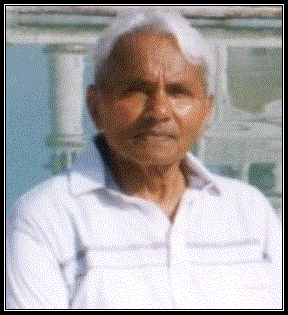 |
It
is with great sorrow that we announced
the passing of Shree Jivanbhai
Nathoobhai Gadher at the age of 84
years.
Coffin draped with the ‘tri –
colour’ of Bharat, India was carried
by his sons and ‘sons in law’.
He was cremated with full honours
in Manchester, UK.
Present were friends and family
from home and abroad
|
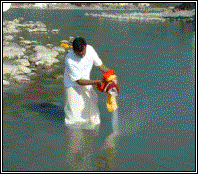 |
6
th December – ‘Pusphe – phool' of
Shree Jivanbhai reached Janma Bhumi
Bharat
8 th December – ‘Pusphe – phool'
(ashes) reached Guru - Charan at
Haridwar, India
|
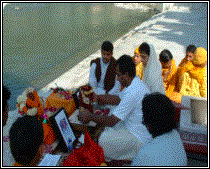 |
9
th December – 16 th Sanskar finalised
– ‘Pusphe – phool' Immersed into
the Ganges
|
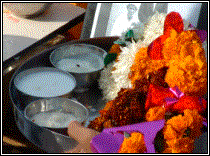 |
10
th December – ‘Havan' and a ‘Maha
Ganga Aarati' at the
banks
of the Ganges
|
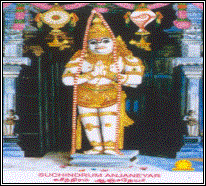 |
12
th
December
– Hanuman Pooja and
Prayers at Sachindram, Tamil Nadu, India
|
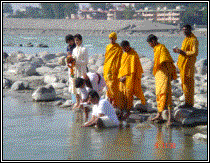 |
25
th December – ‘Suraya Darshan' and
‘Samudra Immersion' at the meeting
point of the three seas – Indian
Ocean, Arabian Sea and the Bay of Bengal
at Kanyakumari, South India. Blessings
from Vivekananda Kendra
|
|
27th
to the 29th August 2005 |
|
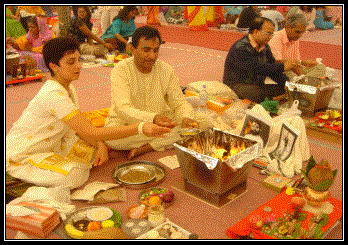
The
final ceremony
was
the ‘Maha Hanumat Yagna’,
performed in memory of Shree Jivanbhai
in the presence of Swami
Satyamitranand Giriji Maharaj – Swami
Sankracharya
at Abbey Park, Leicester.
There were one thousand and eight
havan kundis lit over three days and
20,000 yajamos attended the Ceremonies.
With Blessings from Guruji and
various priests, we concluded the Poojas,
Havans, Aaratis and Ceremonies in memory
of our beloved Shree Jivanbhai Gadher
|
|
 |
 |
 |
|